
NEMA 14-50 vs. Hardwired EV Charger: Sizing & NEC Rules
When installing a Level 2 EV charging station at home, you face a critical electrical decision: do you plug into a 240V NEMA 14-50 outlet or hardwire it directly to your electrical panel? While plugging in seems more convenient, National Electrical Code (NEC) updates, thermal fatigue risks, and modern EV charging speeds have fundamentally shifted the engineering recommendation.
Hardwiring is the superior choice for 90% of EV owners. It is safer, eliminates the requirement for an expensive and trip-prone GFCI circuit breaker, prevents receptacle thermal meltdowns, and unlocks the maximum 48-Amp charging speed (11.5 kW). A NEMA 14-50 plug-in setup should only be used if you are renting or require portable charging, and it limits charging output to 40 Amps (9.6 kW).
Sizing Your Dedicated EV Circuit?
Calculate exact conductor gauge, conduit fill, and breaker sizes under NEC 125% continuous duty rules.
Calculate EV Charger Wire Size →Table of Contents
- 1. The 48-Amp Advantage: Charging Speed Limits
- 2. Installation Cost & Hardware Comparison
- 3. The GFCI Nuisance Tripping Dilemma (NEC 210.8)
- 4. Safety and Reliability: The “Melted Receptacle” Problem
- 5. Conductor Sizing: 6 AWG vs. 4 AWG Requirements
- 6. When Does a NEMA 14-50 Actually Make Sense?
- Frequently Asked Questions
1. The 48-Amp Advantage: Charging Speed Limits
The first fundamental difference between plug-in and hardwired EVSE is continuous current delivery. Under NEC Article 625.42, electric vehicle charging loads are legally classified as continuous loads. This triggers the NEC 125% continuous duty rule (or 80% maximum breaker utilization rule):
- NEMA 14-50 Limit: Standard 14-50 receptacles are installed on a 50-Amp circuit breaker. Applying the 80% maximum continuous load restriction limits your EV charger output to 40 Amps maximum (240V × 40A = 9.6 kW). On many portable or bundled mobile chargers, current is further throttled by software to 32 Amps (7.7 kW).
- Hardwired Limit: Dedicated hardwired charging stations can be paired with a 60-Amp circuit breaker. Operating at 80% continuous duty, the charger delivers a full 48 Amps (240V × 48A = 11.5 kW) directly to the vehicle.
That 1.9 kW difference delivers roughly 6 to 9 additional miles of range per charging hour, shortening overnight replenishment by two to three hours on full-size EV battery packs (e.g., Ford F-150 Lightning, Tesla Model Y Long Range, Hyundai Ioniq 5).
2. Installation Cost & Hardware Comparison
A common misconception is that installing a plug-in receptacle is substantially cheaper. Because modern building codes mandate specialized ground-fault breakers for garage outlets, a code-compliant plug-in installation often costs more than a hardwired run.
| Hardware Item | NEMA 14-50 Plug-In | Hardwired Dedicated |
|---|---|---|
| Circuit Breaker | 50A 2-Pole GFCI Breaker ($130 – $240) | 60A Standard 2-Pole Breaker ($20 – $35) |
| Receptacle Hardware | Industrial Hubbell/Bryant Receptacle ($65 – $95) | Not Required ($0) |
| Conductor Runs | 4 Conductors (Hot, Hot, Neutral, Ground) | 3 Conductors (Hot, Hot, Ground — No Neutral) |
| Max Continuous Current | 40 Amps (9.6 kW) | 48 Amps (11.5 kW) |
| Total Material Overhead | $210 – $360 (Excl. Wire) | $25 – $50 (Excl. Wire) |
3. The GFCI Nuisance Tripping Dilemma (NEC 210.8)
Under NEC Section 210.8(A), all 125-volt through 250-volt receptacles installed in residential garages, outdoors, and accessory buildings require Ground-Fault Circuit-Interrupter (GFCI) protection. If you install a NEMA 14-50 outlet, code compliance dictates a 2-pole GFCI breaker at your main service panel.
However, modern Level 2 chargers contain proprietary CCID (Charge Circuit Interrupting Device) microprocessors that conduct automated ground-leakage checks every few milliseconds. Placing a CCID-monitored EVSE on a panel-level GFCI breaker creates a dual-GFCI resonance loop.
This causes intermittent nuisance tripping in the middle of the night. Homeowners wake up to find their breaker tripped and an uncharged vehicle. Hardwiring bypasses NEC 210.8(A) completely because there is no plug receptacle involved, enabling you to use a standard thermal-magnetic breaker and rely on the internal safety systems of the charger.
4. Safety and Reliability: The “Melted Receptacle” Problem
Standard $10 to $15 NEMA 14-50 outlets found at big-box hardware stores (often Leviton 279-S) are designed for electric kitchen ranges. An electric oven cycles on and off intermittently. Level 2 EV chargers pull a brutal 32A to 40A non-stop for 8 to 10 hours, routinely leading to thermal contact fatigue, arcing, and melted faceplates.
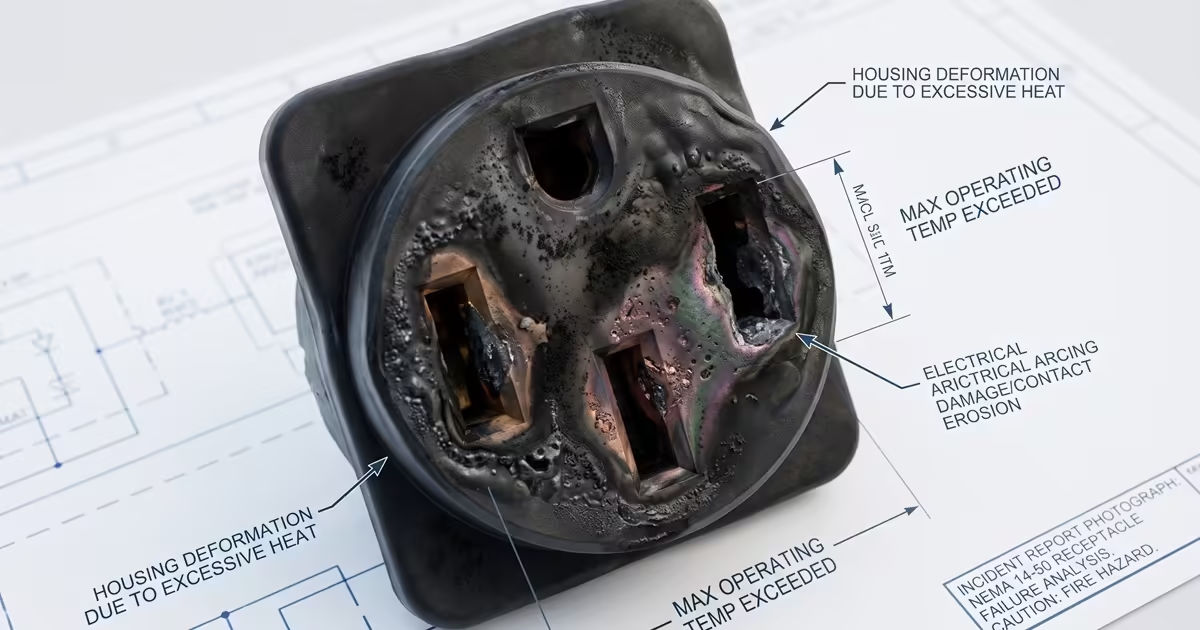
Every mechanical contact point introduces electrical resistance, which scales by $I^2R$ heat dissipation. In a plug-and-receptacle installation, there are three primary failure points:
- Screw terminal connection where feeder wires attach to the back of the receptacle.
- Mechanical spring contact between the receptacle brass jaws and the male plug blades.
- Internal crimp joints inside the molded EVSE plug head.
Over hundreds of thermal expansion cycles, thin residential brass contacts lose spring tension. Once clamping pressure degrades, micro-arcing begins, driving terminal temperatures past 150°C and charring the enclosure. Hardwiring removes the plug and receptacle entirely — heavy copper conductors terminate directly into the torque-rated terminal blocks inside the charger.
5. Conductor Sizing: 6 AWG vs. 4 AWG Requirements
When selecting conductors for a 48-Amp continuous EV charging circuit, cable construction rules dictate conductor gauge selection:
- Individual THHN / THWN-2 Copper in Conduit: Rated under the 75°C termination column of NEC Table 310.16. 6 AWG THHN copper is rated for 65 Amps, making it fully compliant for a 60-Amp circuit breaker feeding a 48-Amp continuous hardwired charger.
- Nonmetallic Sheathed Cable (NM-B / Romex): Governed strictly by NEC Article 334.80, which mandates sizing Romex conductors using the 60°C ampacity column. 6 AWG NM-B copper is restricted to 55 Amps maximum.
Because the next standard breaker size up from 55A is 60A, installing 6 AWG Romex on a 60-Amp breaker feeding a 48-Amp charger violates the National Electrical Code. If your run requires Romex, you must upgrade to 4 AWG NM-B copper (rated 70A at 60°C) or transition to individual 6 AWG THHN conductors inside EMT or PVC conduit.
6. When Does a NEMA 14-50 Actually Make Sense?
While hardwiring is mechanically and economically superior for dedicated home setups, installing a NEMA 14-50 receptacle remains viable in specific circumstances:
- Tenants and Rental Properties: If you are renting a residence, hardwiring permanently integrates equipment into the building. A plug-in charger allows you to unmount the station and pack it without touching the electrical infrastructure.
- Shared Workshop Circuits: If you require a high-amperage 240V outlet for an air compressor, heavy kiln, or stick welder during the day, a 14-50 receptacle offers multi-purpose versatility.
Crucial Safety Rule: If you choose the receptacle route, avoid cheap residential outlets. Install an industrial-grade spec receptacle such as the Hubbell HBL9450A or Bryant 9450FR. These units feature thick, solid copper-alloy clamping jaws and double-screw terminal pressure plates capable of handling continuous thermal loads.
Frequently Asked Questions
Q: Why do NEMA 14-50 outlets melt during EV charging?
A: Standard residential-grade NEMA 14-50 outlets use thin stamped metal leaves designed for intermittent duty cycles. Subjecting them to continuous 32A to 40A draws for 6 to 10 hours causes resistance heating that weakens spring tension, leading to contact arcing and melted receptacles. Hardwiring or installing an industrial-grade receptacle eliminates this failure.
Q: Why does a plug-in EV charger require an expensive GFCI breaker?
A: NEC 210.8(A) mandates Ground-Fault Circuit-Interrupter protection on all 240V receptacles in garages and outdoors. Because EV charging stations already incorporate internal ground-fault protection, placing a plug-in unit on a GFCI breaker causes nuisance tripping. Hardwired units bypass this receptacle rule completely.
Q: What is the maximum charging speed difference between plug-in and hardwired?
A: A NEMA 14-50 plug-in charger on a 50A breaker is restricted under the NEC 80% rule to 40 Amps (9.6 kW). A hardwired station can connect to a 60A circuit breaker, allowing a continuous 48 Amps (11.5 kW), which provides roughly 20% faster charging speeds.
Final Verdict: Skip the receptacle — hardwire your EV charger for a safer connection, lower material costs (no expensive GFCI breaker or industrial outlet required), complete immunity to nuisance tripping, and faster 48A charging speeds.
Securing Your EV Charging Cables & Hardware?
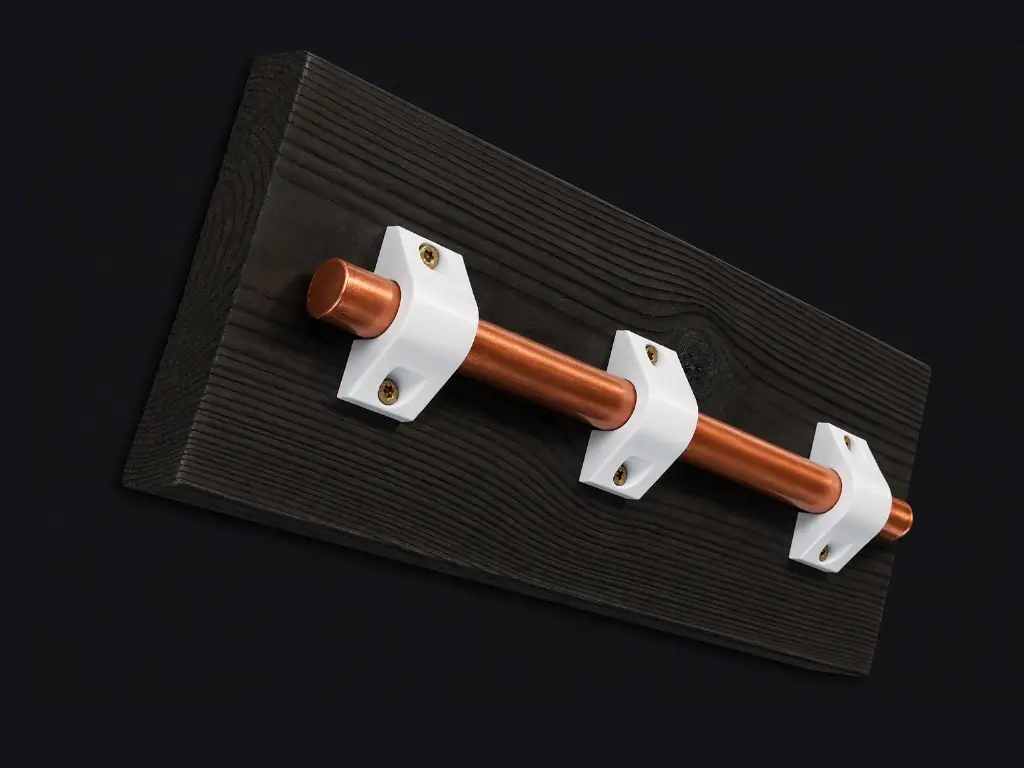
Keep your garage wall neat and eliminate heavy cord strain on your charger socket. Check out our heavy-duty EV cable organizer and holster bracket, engineered with a 12° drainage angle and 3D printed in UV-resistant PETG.