
Understanding the NEC 125% Continuous Load Rule for EV Chargers
If you are installing a Level 2 electric vehicle charger, you will quickly encounter one of the most important safety regulations in the National Electrical Code (NEC): The 125% Continuous Load Rule. Understanding this rule is the absolute key to preventing nuisance tripped breakers, melted wiring, and catastrophic electrical fires.
The NEC dictates that any electrical device running at maximum power for 3 hours or more is a “continuous load.” Because EV chargers run for many hours, your circuit breaker and wire gauge must be sized to handle 125% of the charger’s maximum output. Alternatively, you can think of it as the 80% rule: your charger can only pull 80% of your breaker’s total capacity.
Sizing a Continuous Load Circuit?
Let our calculator handle the 125% math. Calculate exact conductor gauge, conduit fill, and breaker sizes for your specific Level 2 charger.
Calculate EV Charger Wire Size →Table of Contents
1. What Exactly is a “Continuous Load”?
In electrical engineering, loads are categorized by how long they draw maximum current. A microwave, for example, might pull 1,500 watts, but it only runs for a few minutes at a time. This is a non-continuous load.
According to NEC Article 100, a continuous load is defined as any electrical load where the maximum current is expected to continue for 3 hours or more.
Because modern electric vehicles have massive battery packs (often 70kWh to 130+ kWh), charging from empty to full on a Level 2 home charger usually takes 6 to 12 hours. Therefore, under NEC Article 625.42, EV charging equipment is always strictly classified as a continuous load.
2. The Math: 125% Rule vs. 80% Rule
You will often hear electricians refer to both the “125% rule” and the “80% rule.” They are exactly the same mathematical principle, just calculated from opposite directions depending on whether you are buying the charger first or using an existing breaker.
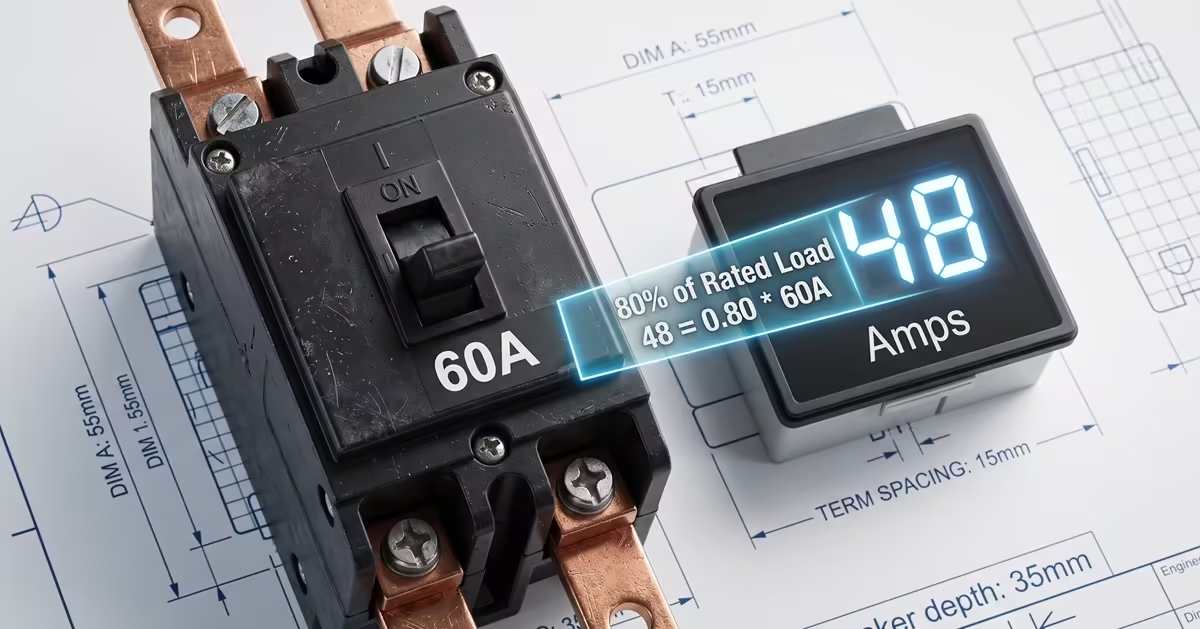
- The 125% Rule (Sizing the Breaker): If you know the output of your EV charger, multiply it by 1.25 to find the minimum circuit breaker size.
Example: A 48-Amp charger × 1.25 = 60-Amp breaker required. - The 80% Rule (Sizing the Charger): If you already have a circuit breaker installed, multiply its rating by 0.80 to find the maximum charging speed allowed.
Example: A 50-Amp breaker × 0.80 = 40-Amp maximum charging speed.
This is exactly why you cannot plug a 50-Amp charger into a standard 50-Amp circuit breaker. The continuous load would trip the breaker and pose a severe fire hazard.
3. Why Does the NEC Require This? (The Heat Factor)
Circuit breakers are thermal-magnetic devices. When electricity flows through a wire, it generates heat due to electrical resistance. If a load is run at 100% of a breaker’s capacity for hours, the heat cannot dissipate fast enough. The breaker will overheat, the wire insulation will melt, and an electrical fire can ignite inside your walls.
By forcing you to oversize the circuit by 25% (or derate the load to 80%), the NEC ensures there is “thermal headroom.” This allows the copper wires and the breaker’s internal components to naturally radiate heat without exceeding their safe temperature limits (which is usually 60°C or 75°C for residential wiring).
This rule also applies to your wires. The wire gauge must be sized for the breaker size, not just the charger size. Selecting the right wire is critical; thin wire acting as a bottleneck gets dangerously hot, acting like the heating element in a toaster.
4. Standard EV Charger & Breaker Size Pairings
To make it easy, here is a reference table showing the correct circuit breaker size for popular Level 2 EV charger outputs based on the continuous load rules.
| Charger Output (Amps) | Required Breaker Size (Amps) | Common Installation Type |
|---|---|---|
| 16 Amps (3.8 kW) | 20 Amps | NEMA 6-20 Plug |
| 24 Amps (5.7 kW) | 30 Amps | NEMA 14-30 / Hardwired |
| 32 Amps (7.6 kW) | 40 Amps | Hardwired or NEMA 14-50 |
| 40 Amps (9.6 kW) | 50 Amps | Hardwired or NEMA 14-50 |
| 48 Amps (11.5 kW) | 60 Amps | Hardwired Only |
| 80 Amps (19.2 kW) | 100 Amps | Hardwired Only (Ford Pro) |
5. How the 125% Rule Impacts Wire Gauge Sizing
Oversizing the breaker is only half the equation. You must also select a conductor gauge capable of safely carrying that continuous load. For example, if you are installing a 48-Amp hardwired charger on a 60-Amp breaker:
- You cannot use 6 AWG NM-B (Romex). Under NEC 334.80, Romex is restricted to the 60°C temperature column, meaning 6 AWG Romex maxes out at 55 Amps. A 60-Amp breaker violates code.
- To satisfy the 125% rule for a 48A charger, you must use 6 AWG THHN/THWN-2 in conduit (rated for 65A at 75°C) or upsize your Romex to 4 AWG NM-B (rated for 70A at 60°C).
Frequently Asked Questions
Q: What exactly is considered a continuous load by the NEC?
A: According to NEC Article 100, a continuous load is any electrical load where the maximum current is expected to continue for 3 hours or more. Because electric vehicles take 6 to 10 hours to fully charge, EV chargers are always legally classified as continuous loads.
Q: Is the 125% rule the same as the 80% rule?
A: Yes, they are mathematically identical concepts viewed from opposite directions. You multiply the charger’s output by 125% to find the required breaker size, or you multiply a breaker’s rating by 80% to find the maximum safe continuous load you can draw from it.
Q: Why doesn’t the breaker just handle 100% of its rated capacity?
A: Standard thermal-magnetic breakers trip based on heat accumulation. If you pull 100% of a breaker’s rated capacity for several hours, the breaker and attached wires cannot dissipate heat fast enough, leading to nuisance thermal trips and eventual hardware degradation. The 125% rule guarantees 20% “thermal headroom.”
Final Tip: Never cut corners on circuit sizing. Always ensure your circuit breaker satisfies the 125% rule, and the wire ampacity matches the breaker rating to guarantee a fire-safe EV charging installation.
Securing Your EV Charging Cables & Hardware?
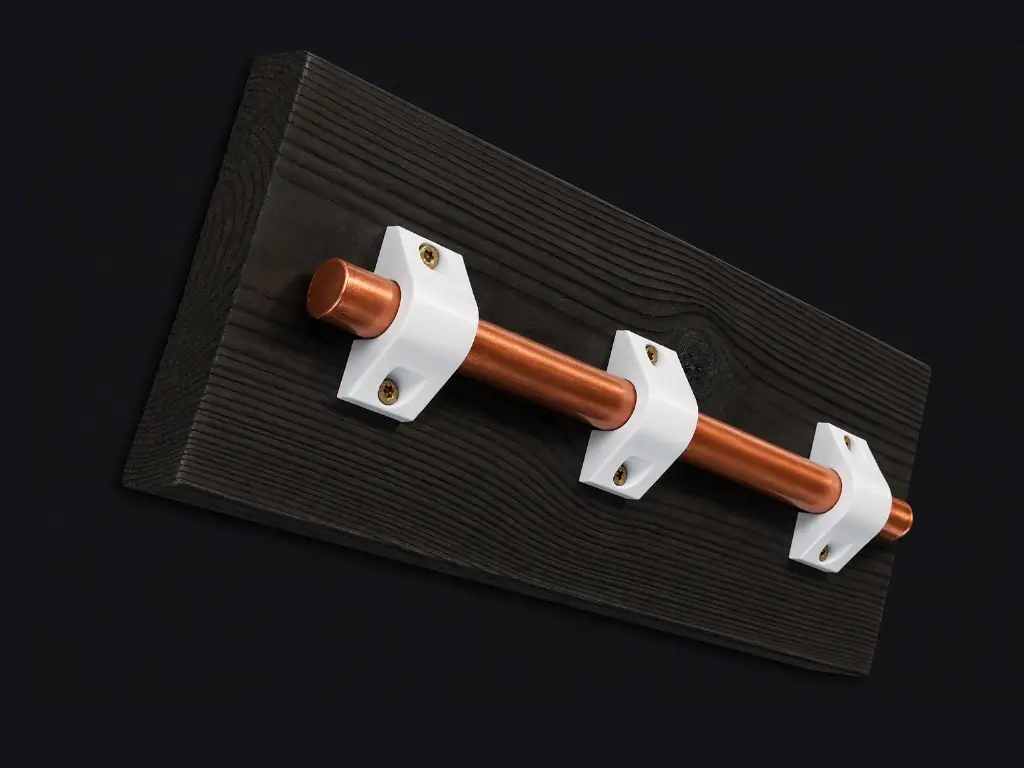
Keep your garage wall neat and eliminate heavy cord strain on your charger socket. Check out our heavy-duty EV cable organizer and holster bracket, engineered with a 12° drainage angle and 3D printed in UV-resistant PETG.