

Sizing Wire for Bow-Mount Marine Trolling Motors (12V, 24V, 36V Systems)
Equipping a modern bass boat, skiff, or center console with a high-thrust bow-mount trolling motor introduces one of the most demanding direct current (DC) circuits in marine electrical engineering. Trolling motors routinely draw between 45 and 60 amps of continuous current while fighting wind, current, or heavy vegetation. Because the battery bank is typically located at the stern for weight distribution, pushing 60 amps over a 20-foot run (40 feet round-trip) to the bow creates massive electrical resistance, leading to severe voltage drop if the conductors are undersized.
Unlike intermittent loads such as horn compressors or trim tabs, trolling motors operate continuously. Failing to properly size conductors according to the American Boat and Yacht Council (ABYC) E-11 standards not only robs the motor of thrust and drastically shortens your time on the water, but it also creates extreme thermal heat inside your hull. Wiring a 12V, 24V, or 36V system correctly requires calculating circular mils, factoring round-trip distance, and strictly utilizing UL 1426 tinned marine-grade copper.
Need Exact Wire Sizing for Your DC Run?
Input your trolling motor’s max amperage, total round-trip distance, and select a 10% safety margin to instantly calculate the ABYC-compliant AWG.
In This Guide:
The Impact of Voltage Drop on Thrust (ABYC 10% Rule)
Under the ABYC E-11 standard, a trolling motor is classified as a non-critical circuit, meaning it is legally permitted to experience a maximum voltage drop of 10%. However, professional riggers and tournament anglers often size their conductors for a stricter 5% voltage drop to ensure maximum propeller thrust and to prevent the motor’s control board from shutting down prematurely as the batteries deplete.
Voltage drop is calculated using the Circular Mils formula for direct current:
CM = (10.75 × I × L) / ΔV
Where:
- 10.75: The resistivity constant for copper ($K$).
- I: The maximum continuous current (amperage) drawn by the motor.
- L: The total round-trip circuit distance in feet (from battery to bow and back).
- ΔV: The allowable voltage drop (e.g., $24text{V} times 0.10 = 2.4text{V}$).
If you run a 12V motor pulling 50 amps over a 15-foot hull (30 feet round-trip) using undersized 10 AWG wire, the voltage drop will exceed 1.5 volts (a 12.5% loss). By the time the power reaches the bow, your 12.6V battery is only delivering 11.1V, significantly reducing motor RPM and generating dangerous heat in the wires.
12V vs. 24V vs. 36V Systems: How Higher Voltage Saves Wire Size
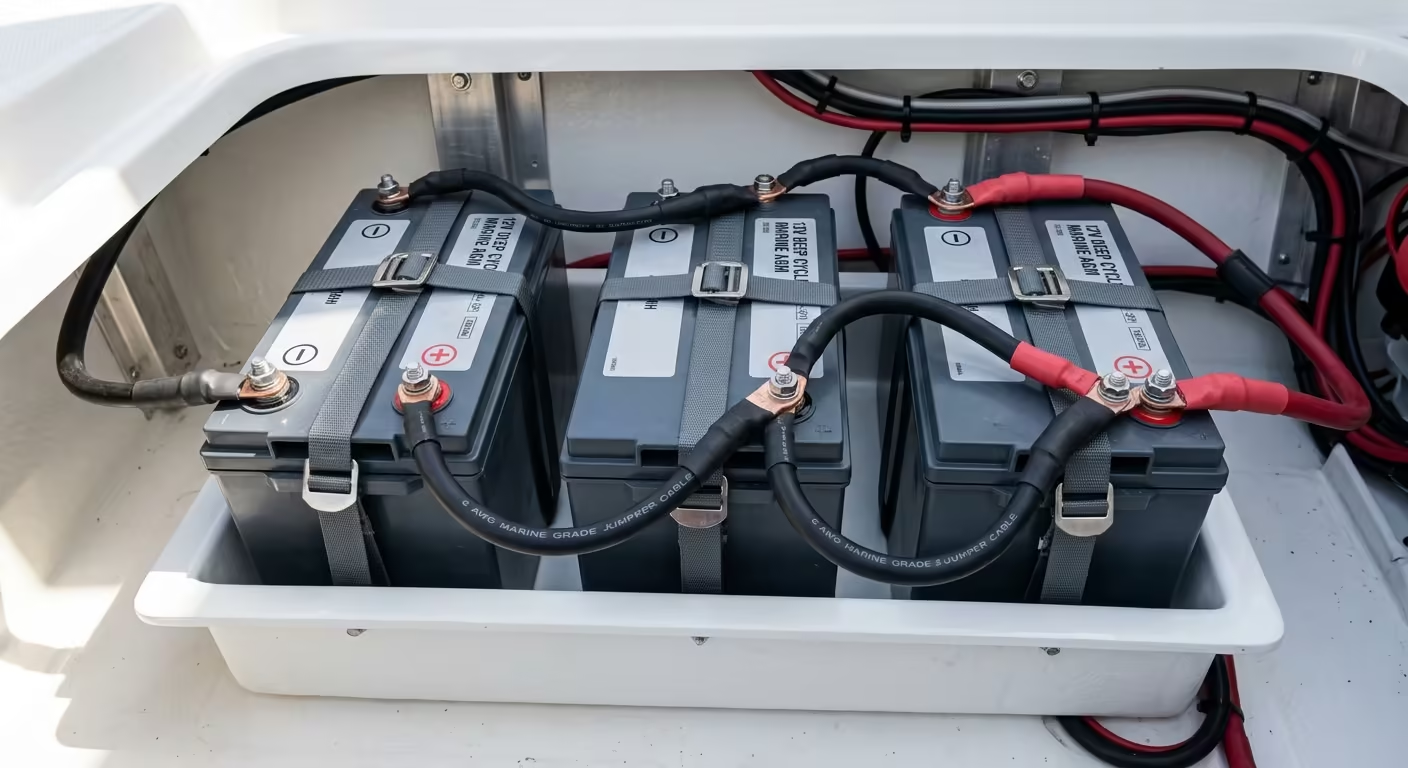
As boats get larger and heavier, trolling motor manufacturers (like Minn Kota, MotorGuide, and Garmin) increase the thrust capacity. To deliver more watts without melting wires, they step the voltage up to 24V (two batteries in series) or 36V (three batteries in series). Because $Watts = Volts times Amps$, tripling the voltage allows the motor to draw roughly the same amperage while producing three times the power.
- 12V Systems (up to 55 lbs thrust): Draw approximately 50 Amps at maximum speed. Because the starting voltage is so low (12V), a 10% drop is only 1.2V. You must use massive cables (usually 6 AWG) just to keep the voltage from crashing over long distances.
- 24V Systems (up to 80 lbs thrust): Draw approximately 56 Amps at maximum speed. A 10% allowable drop gives you a 2.4V buffer, allowing you to easily run 6 AWG or sometimes 8 AWG over medium distances.
- 36V Systems (up to 112 lbs thrust): Draw approximately 52 Amps at maximum speed. With a starting voltage of 36V, a 10% drop allows a massive 3.6V buffer. 8 AWG wire will easily carry this load, though 6 AWG remains the gold standard for peak tournament performance.
Sizing the Trolling Motor Circuit Breaker
The circuit breaker protects the wire, not the motor. However, electric motors experience an “inrush” or “locked rotor” surge when starting, or when the propeller gets tangled in thick weeds. If your breaker is sized too closely to the running amps, it will nuisance-trip constantly.
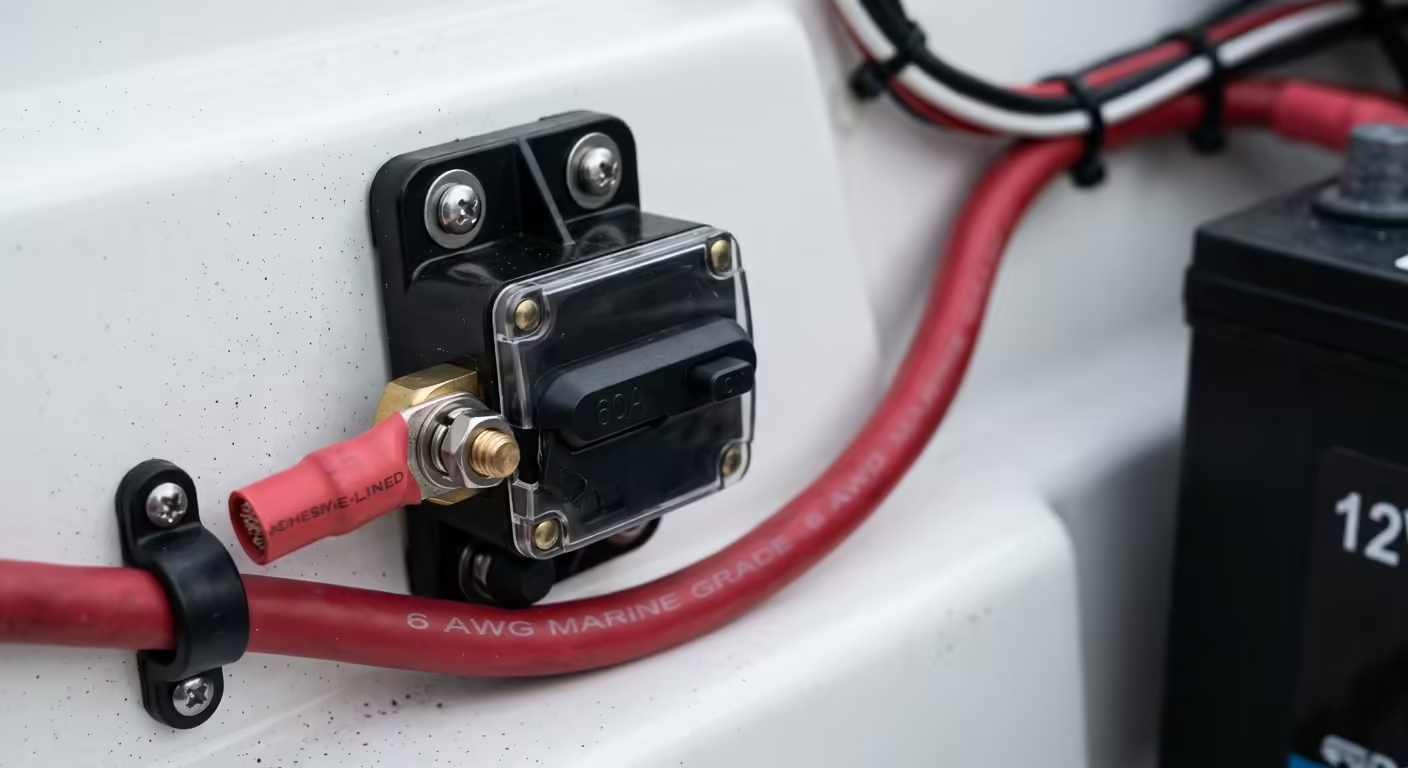
For modern 24V (56A) and 36V (52A) trolling motors, manufacturers universally require a 60-Amp continuous marine circuit breaker. To safely support a 60A breaker, the conductors must be rated for at least 60 amps. Under ABYC ampacity tables, 8 AWG tinned copper is rated for 68 amps (outside of engine spaces), and 6 AWG tinned copper is rated for 102 amps. Therefore, both 8 AWG and 6 AWG satisfy the thermal requirements for a 60A breaker, leaving distance (voltage drop) as the deciding factor.
Trolling Motor Wire Sizing Reference Chart
The table below provides minimum recommended AWG conductor sizes targeting a conservative 5% to 10% voltage drop across standard hull lengths. (Distances listed are One-Way from battery to bow; the math accounts for the round trip).
| Motor Voltage / Thrust | Max Amp Draw | 10 ft One-Way Run | 15 ft One-Way Run | 20 ft One-Way Run |
|---|---|---|---|---|
| 12V (up to 55 lbs) | 50 Amps | 8 AWG | 6 AWG | 4 AWG |
| 24V (up to 80 lbs) | 56 Amps | 8 AWG | 6 AWG | 6 AWG |
| 36V (up to 112 lbs) | 52 Amps | 8 AWG | 8 AWG | 6 AWG |
*Industry Best Practice: While 8 AWG works for many 24V and 36V setups, rigging the entire boat with 6 AWG marine tinned copper is the undisputed standard. It eliminates voltage drop concerns, keeps wiring cool, and allows you to upgrade to a higher-thrust motor in the future without pulling new wire.
Frequently Asked Questions
Q: Can I use standard automotive jumper cables to wire my trolling motor?
A: No. Automotive wire uses bare copper strands that quickly oxidize and turn black in humid marine environments. You must use UL 1426 Marine Grade Tinned Copper wire (Class K stranding), which is specifically engineered to resist saltwater corrosion and hull vibration.
Q: What size wire should I use to connect my 12V batteries in series?
A: The “jumper” wires connecting your batteries in series (to create 24V or 36V) carry the exact same maximum amperage as the main run to the bow. Therefore, the series jumper wires must be identical in size to your main conductor run (e.g., 6 AWG).
Q: Do I need a ground block or negative busbar for a trolling motor?
A: It is highly recommended. Rather than stacking multiple ring terminals directly onto the battery’s negative post (which causes poor contact and localized heating), run your heavy 6 AWG negative wire to a solid brass or tinned copper marine busbar.
Securing Your Marine Cables?
Keep your hull wiring neat, secure, and ABYC compliant. Check out our parametric conduit clamps and marine cable organizers, custom-engineered and 3D printed in rugged industrial PETG.
