
Sizing Wire from RV Solar Panels to the Charge Controller
Harnessing solar energy on the roof of an RV is highly inefficient if the electrical power is bottlenecked by undersized wiring before it ever reaches your battery bank. The wire run from the rooftop solar array down to the MPPT charge controller is highly susceptible to voltage drop. Because solar panels operate on variable DC voltage that fluctuates with cloud cover and sun angle, any additional resistance in the wiring directly reduces the wattage harvested by your system.
Determining the correct wire gauge requires evaluating the total wattage of your array, the round-trip distance from the roof to the interior utility bay, and whether your panels are wired in series or parallel. Sizing these cables incorrectly can lead to severe energy losses, melted MC4 connectors on your roof, or failure to trigger the charge controller’s minimum wake-up voltage.
Running DC Cables from Roof to Controller?
Eliminate dangerous voltage drop and pinpoint the exact AWG size for your RV and Marine solar runs.
In This Guide:
Series vs. Parallel: The Voltage Drop Factor
How you connect your solar panels fundamentally changes the wire gauge required. When sizing DC circuits, amperage is the enemy of thin wires because high amperage creates heat and voltage drop.
- Wiring in Parallel: Amperage adds up, but voltage stays the same. Four 100W (5A / 20V) panels wired in parallel will send 20 Amps at 20 Volts down the roof cable. This high amperage requires thick, expensive wire (like 6 AWG or 4 AWG) to prevent crippling voltage drop over a 20-foot run.
- Wiring in Series: Voltage adds up, but amperage stays the same. Those same four 100W panels wired in series will send 5 Amps at 80 Volts down the roof cable. Because the amperage is so low, you can safely use standard, flexible 10 AWG solar wire without experiencing significant voltage drop.
For modern RVs utilizing MPPT (Maximum Power Point Tracking) charge controllers, wiring panels in series or series-parallel is strongly recommended. MPPT controllers can accept high input voltages (often up to 100V or 150V) and step it down to 12V or 24V for the battery bank, allowing you to run thinner wire from the roof.
MC4 Connectors and 10 AWG Limits
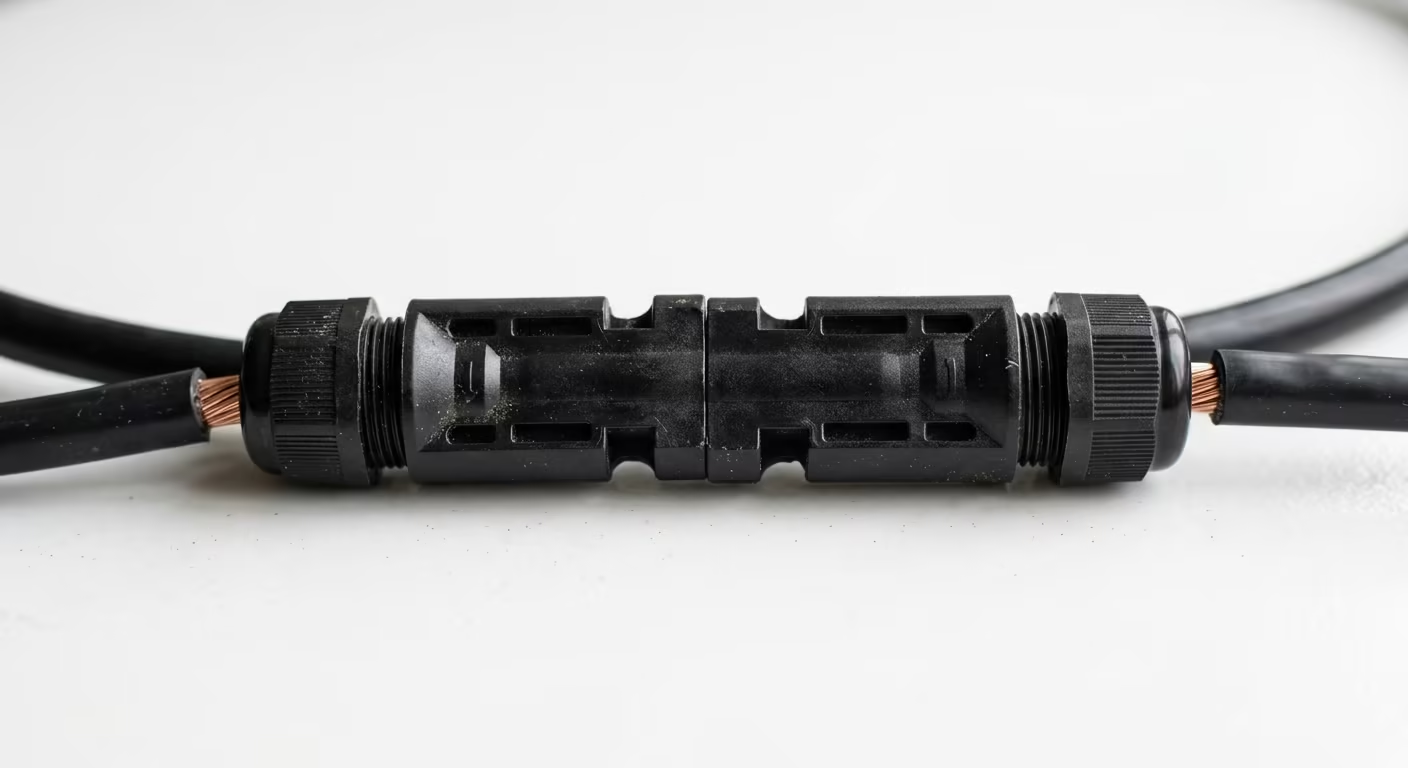
Almost all rigid RV solar panels come pre-wired with MC4 connectors. These waterproof snap-in terminals are the industry standard, but they have a hard physical limitation: standard MC4 connectors are only rated to handle a maximum of 30 Amps, and the internal crimp pins are designed to accept a maximum wire size of 10 AWG.
RV Solar Wire Sizing Chart (400W to 1200W)
To keep energy harvesting efficient, size your solar cables for a maximum 3% voltage drop. The table below illustrates the minimum required AWG for a typical RV roof-to-controller run (assuming a 30-foot round-trip distance):
| Array Size | Configuration | Output (Volts / Amps) | Required Wire (30ft Run) |
|---|---|---|---|
| 400 Watts | All Parallel | 20V / 20A | 6 AWG |
| 400 Watts | All Series | 80V / 5A | 10 AWG |
| 800 Watts | Series-Parallel (2x400W) | 40V / 20A | 8 AWG |
| 1200 Watts | Series-Parallel (3x400W) | 60V / 20A | 10 AWG |
Frequently Asked Questions
Q: Should I fuse the solar panels on the roof?
A: Generally, no. If you only have one or two strings of panels, the maximum short-circuit current of the panels is not enough to melt 10 AWG wire. However, you MUST install a DC breaker or fuse between the solar charge controller and the battery bank.
Securing Your Electrical Conduits & Cables?
Keep your electrical installations neat and code-compliant. Check out our parametric conduit clamps and cable organizers, custom-engineered and 3D printed in rugged industrial PETG.