
Sizing Battery Cables for 2000W & 3000W Marine Inverters
Adding a large 2000W or 3000W pure sine wave inverter to your boat or RV completely transforms off-grid living, allowing you to run microwaves, coffee makers, and even air conditioning straight from your battery bank. However, converting 12V DC power into 120V AC power requires moving massive amounts of electrical current.
Because the source voltage is so low (12 Volts), the amperage required to hit 3000 Watts is staggering. An undersized cable on a heavy-duty inverter will not only throttle the inverter’s performance and cause low-voltage shutoffs, but it also creates immense resistance heat, leading to melted insulation or electrical fires.
Running DC Cables from Battery to Inverter?
Eliminate dangerous voltage drop and pinpoint the exact ABYC AWG size for your marine DC circuits instantly.
In This Guide:
The Math: How Many Amps Does a 12V Inverter Draw?
To determine wire size, we first need to calculate the maximum continuous amperage. Inverters are not 100% efficient—some power is lost as heat during the inversion process. A standard safety calculation divides the total wattage by the lowest voltage threshold (usually 10.5V to 11V before the inverter cuts off) and factors in an 85% to 90% efficiency rating.
A simple rule of thumb for 12V inverters: Divide the continuous Wattage rating by 10 to get the maximum DC amperage draw.
- 2000W Inverter: 2000W / 10 = ~200 Amps DC
- 3000W Inverter: 3000W / 10 = ~300 Amps DC
Moving 300 amps of current requires cables thicker than your thumb, and those cables must be kept as short as physically possible to prevent voltage drop.
ABYC Cable Sizing Chart (2000W & 3000W)
The American Boat and Yacht Council (ABYC) E-11 standards dictate that cables for critical loads, or loads highly sensitive to voltage sags like inverters, must be sized for a maximum 3% voltage drop. Note that in DC math, the distance must be calculated as the round-trip length (the length of the positive cable plus the length of the negative cable).
| Inverter Size (12V) | Max Amperage | Up to 6ft Round-Trip | 6ft to 10ft Round-Trip |
|---|---|---|---|
| 2000 Watts | 200A | 2/0 AWG | 4/0 AWG |
| 3000 Watts | 300A | 4/0 AWG | Dual 2/0 AWG |
Mandatory Protection: The Class T Fuse
Large lithium (LiFePO4) or AGM battery banks can discharge thousands of amps instantly during a dead short. Standard ANL fuses or cheap circuit breakers can actually weld closed or arc over during a catastrophic short, failing to break the circuit.
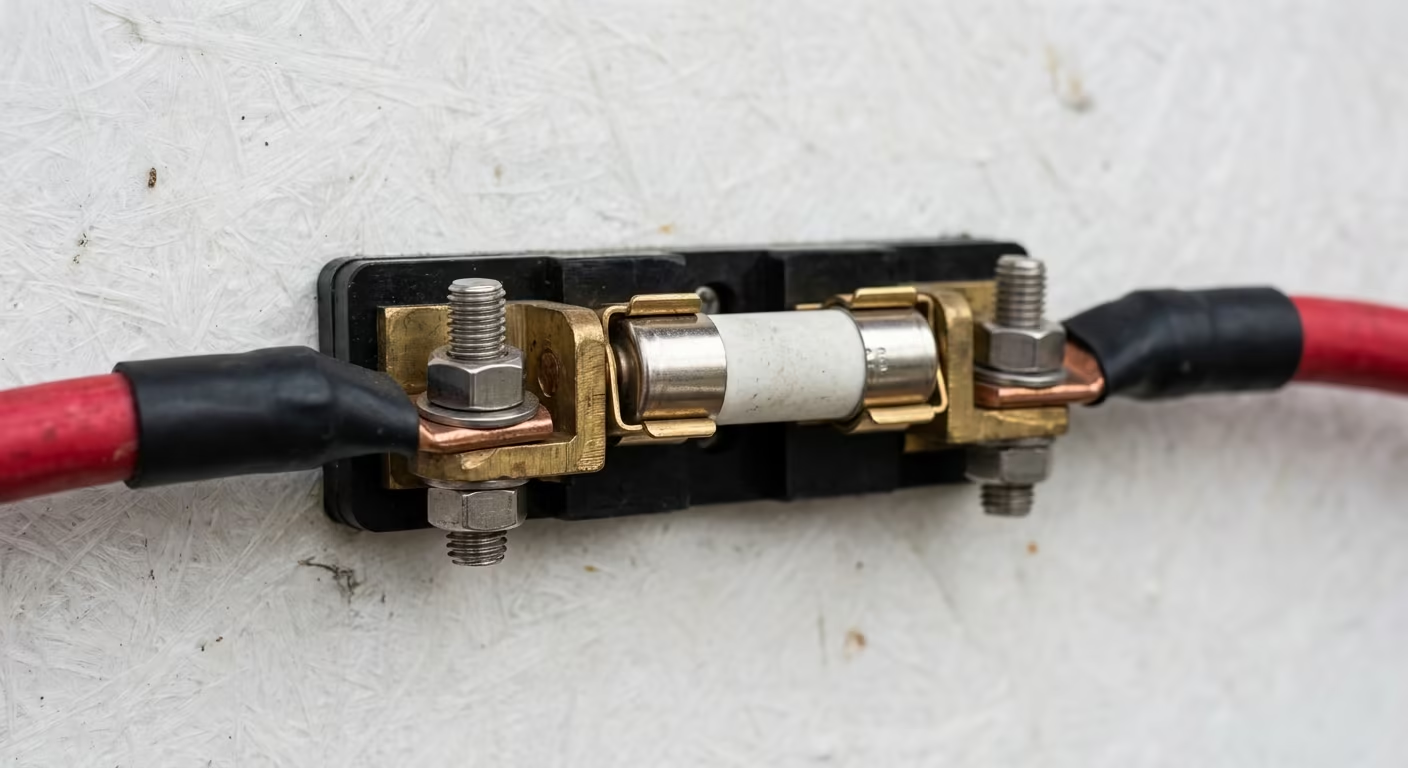
For heavy inverters, ABYC standards require a Class T fuse. Class T fuses have an incredibly high Interrupting Rating (up to 20,000 amps), ensuring they will physically blow and stop the current flow regardless of how powerful the battery bank is. The fuse must be sized to protect the wire capacity, not just the inverter load (e.g., a 400A Class T fuse for 4/0 AWG wire) and must be placed within 7 inches of the positive battery terminal.
Why Tinned Copper is Non-Negotiable
Never use automotive jumper cables, CCA (Copper Clad Aluminum), or standard bare copper welding wire on a boat. Marine environments are highly corrosive. Bare copper oxidizes rapidly, turning black and brittle, which increases resistance and chokes the inverter.
ABYC compliance requires BC-5W2 Type III Stranded Tinned Copper. Every individual micro-strand inside the cable is coated in tin, making it highly flexible to withstand hull vibration and nearly immune to saltwater corrosion.
Securing Heavy Battery Cables?
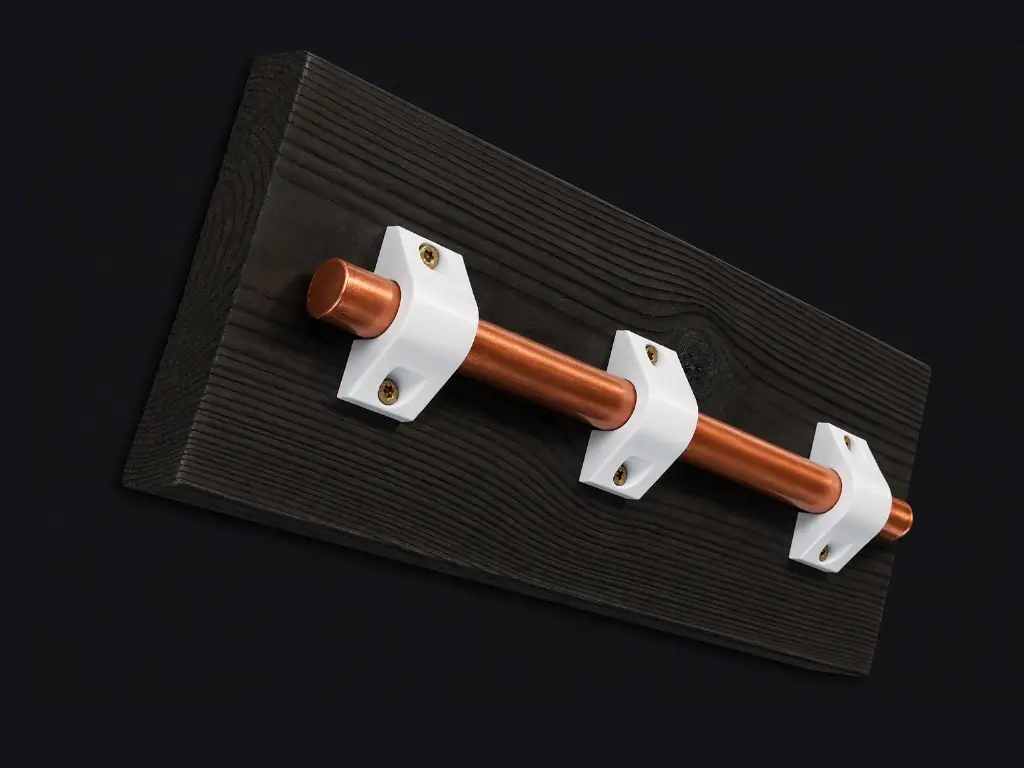
Thick 4/0 inverter cables are heavy and can tear terminals loose if left unsupported. Keep your electrical runs secure with our parametric 3D printable cable cleats.