

High-Voltage Solar Array String Wire Sizing (300V–600V String Inverters)
When designing a rooftop solar photovoltaic (PV) system around a centralized string inverter, electrical engineering dynamics shift dramatically compared to low-voltage 12V or 48V battery systems. By wiring 10 to 15 solar panels in series, string inverters push direct current (DC) potentials up to 300V, 400V, or even 600V. This high-voltage architecture allows system designers to transmit thousands of watts of solar energy across long rooftop and exterior conduit runs using surprisingly thin conductors.
However, managing 600 volts of continuous DC power introduces severe arc-fault and thermal risks. Sizing conductors for high-voltage strings requires strictly adhering to National Electrical Code (NEC) Article 690. You must account for the 156% continuous short-circuit multiplier (NEC 690.8), brutal rooftop ambient temperature deratings (NEC Table 310.15), and the critical cold-weather voltage correction factor (NEC 690.7) to ensure your system never breaches the maximum voltage limit of your inverter or residential code limits.
Calculating Solar DC Wire Size & Voltage Drop?
Input your string voltage, short-circuit current (Isc), one-way distance, and allowable voltage drop to compute the exact AWG gauge needed.
In This Guide:
NEC 690.7: Cold-Weather Voltage Adjustments (The 600V Limit)
Under NEC Section 690.7(C), the maximum permitted DC circuit voltage for a photovoltaic system on a one- or two-family dwelling is strictly capped at 600 Volts DC. Commercial systems may scale to 1000V or 1500V, but residential strings must remain under 600V at all times.
Because solar panels become more efficient as temperatures drop, their Open-Circuit Voltage (Voc) spikes during cold winter mornings. You cannot simply add up the nominal Voc of your panels at room temperature. You must apply a temperature correction factor based on the lowest expected ambient temperature in your region to ensure the cold-weather spike does not exceed 600V or the inverter’s maximum input capacity.
Max Cold Voltage = Panel Voc × Panels in Series × Temperature Correction Factor
If a 400W panel has a Voc of 37.1V, a string of 14 panels produces 519.4V at Standard Test Conditions (25°C). However, if your local winter temperature drops to -10°C (14°F), applying an NEC Table 690.7(A) correction factor of 1.14 pushes the maximum string voltage to 592 Volts—safely below the 600V limit, but dangerously close. Exceeding 600V violates residential electrical codes and will permanently damage the string inverter’s capacitors.
NEC 690.8: Calculating Maximum String Current (1.56 Multiplier)
High-voltage strings keep current relatively low, but conductor ampacity must still be calculated meticulously. NEC 690.8(A)(1) requires that the maximum circuit current is defined as the panel’s Short-Circuit Current (Isc) multiplied by 1.25 to account for intense irradiance spikes (e.g., edge-of-cloud lensing).
Furthermore, because solar production is considered a continuous load (lasting 3 hours or more), NEC 690.8(B) requires an additional 125% continuous duty multiplier when sizing uncorrected conductors and overcurrent devices.
Minimum Uncorrected Ampacity = Isc × 1.25 × 1.25 = Isc × 1.56
For a modern high-efficiency module with an Isc of 13.5 Amps, the baseline conductor ampacity requirement is 13.5A × 1.56 = 21.06 Amps. A standard 10 AWG copper conductor (rated for 40A at 90°C) easily satisfies this requirement, even after applying severe rooftop ambient temperature deratings under NEC Table 310.15(B)(1).
Voltage Drop Efficiency in 400V–600V DC Circuits
The primary engineering advantage of high-voltage series strings is the eradication of voltage drop over long distances. According to the voltage drop formula, the loss is proportional to current, not total wattage.
Consider a 5,000-watt solar array located 150 feet from the inverter, wired in a single 400V string (drawing roughly 12.5 Amps) using standard 10 AWG copper:
ΔV = (2 × 12.9 × 12.5 × 150) / 10,380ΔV = 48,375 / 10,380 = 4.66 Volts
A loss of 4.66 Volts on a 400V circuit represents a microscopic 1.16% voltage drop. This is exceptionally efficient. To achieve that same 5,000-watt transmission with a 48V system over 150 feet, you would need to pull massive 4/0 AWG cables to prevent a crippling 15% voltage loss. By stepping the voltage up to 400V, standard 10 AWG PV wire becomes perfectly adequate for long-distance residential runs.
Wire Type Transition: PV Wire to THWN-2 in Conduit
The NEC dictates specific insulation types based on exposure:
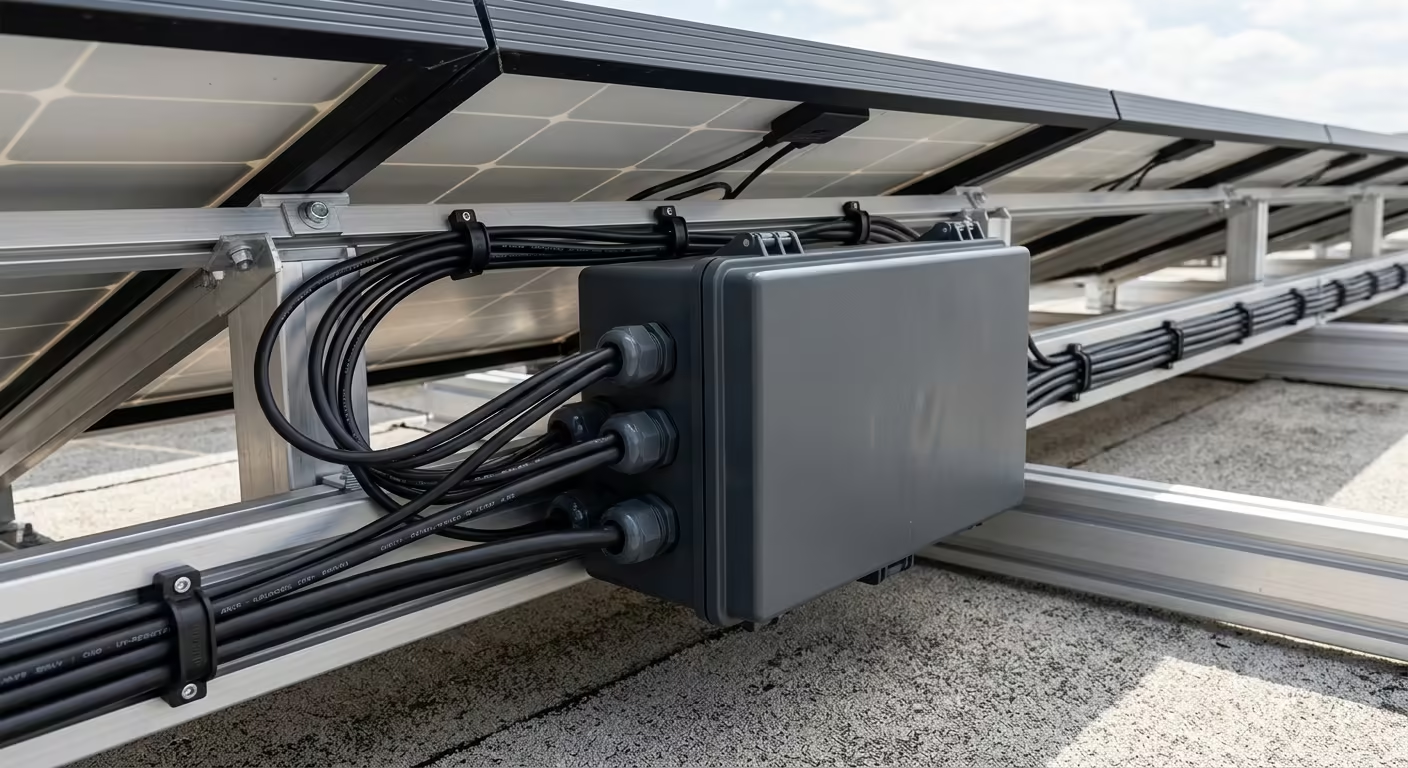
- Exposed Rooftop Wiring: Must be UL 4703 listed Photovoltaic (PV) Wire (typically 10 AWG). This wire has ultra-thick XLPE insulation designed to withstand decades of direct UV radiation, moisture, and extreme heat.
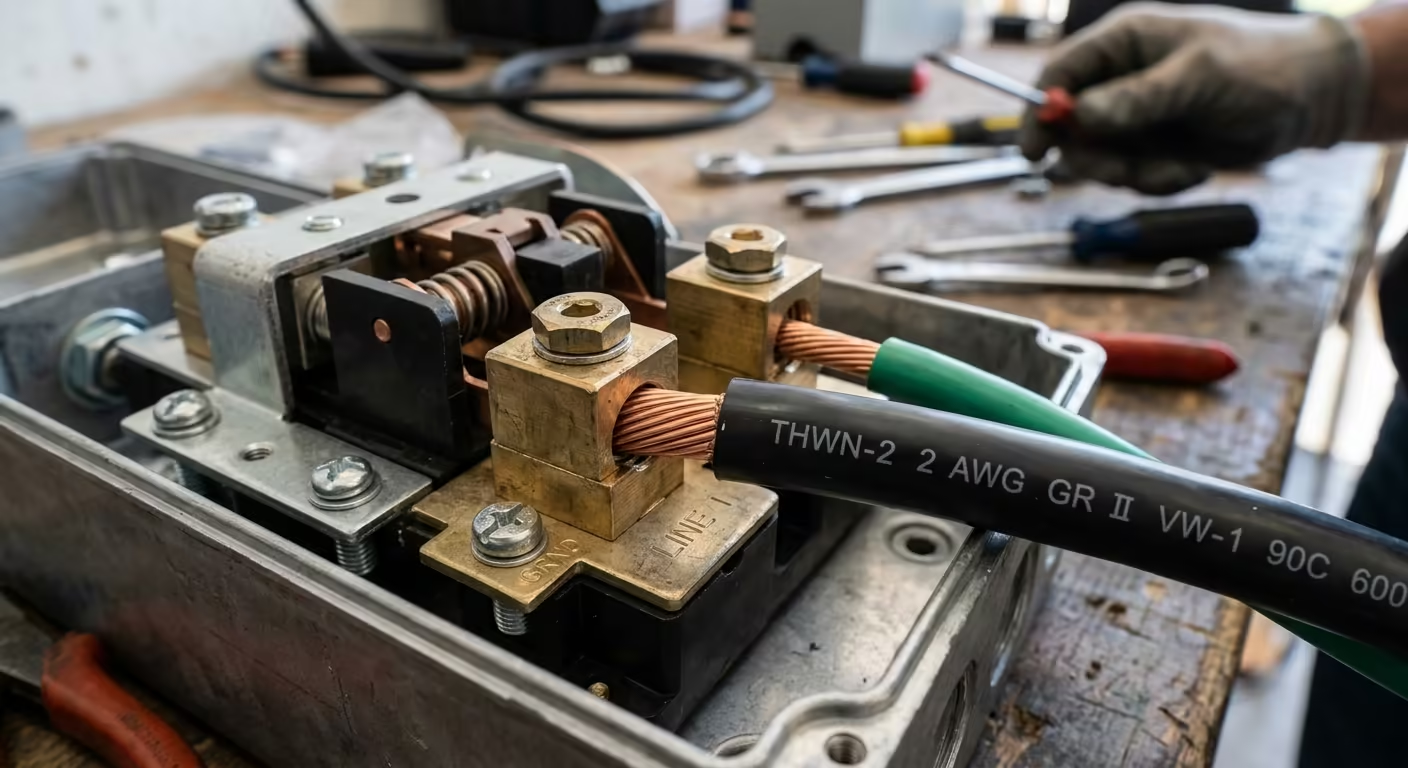
- Interior Conduit Runs: Once the conductors penetrate the roof through a flashed junction box (SolaDeck or similar) and enter EMT or PVC raceway, PV wire is no longer required. It is standard practice to transition via terminal blocks or heavy-duty wire nuts to THWN-2 / THHN copper stranded building wire. THWN-2 is thinner, significantly easier to pull through long conduit sweeps, and rated for the 90°C temperatures expected in attic raceways.
Frequently Asked Questions
Q: Can I use 12 AWG wire for a high-voltage solar string?
A: While 12 AWG copper is technically rated for 20A to 30A depending on the temperature column, almost all modern solar panel connectors (MC4) and inverter terminals are optimized for 10 AWG wire. Furthermore, 10 AWG provides a better thermal buffer for the 1.56 continuous short-circuit multiplier required by NEC 690.8.
Q: What happens if my string voltage exceeds 600V DC on a residential home?
A: Exceeding 600V DC on a one- or two-family dwelling violates NEC 690.7(C). More critically, it exceeds the dielectric breakdown limit of residential 600V-rated insulation and the input capacitor limits of most residential string inverters, leading to permanent equipment destruction and severe fire hazard.
Q: Do I need a separate ground wire for the solar panel frames?
A: Yes. NEC 690.43 requires all exposed metal module frames and mounting rails to be bonded to an Equipment Grounding Conductor (EGC). This is typically a bare 10 AWG or 8 AWG solid copper wire secured to the frames using UL 2703 listed grounding lugs, which routes back through the conduit to the main grounding bus.
Securing Your Electrical Conduits & Cables?
Keep your electrical installations neat and code-compliant. Check out our parametric conduit clamps and cable organizers, custom-engineered and 3D printed in rugged industrial PETG.
