
Conduit Sizing and Wire Pulling for Dual EV Charger Circuits
As multi-EV households become common, many homeowners opt to pull two sets of charging conductors through a single conduit homerun from the main electrical panel to the garage. While this saves labor and material costs compared to running two separate raceways, placing multiple high-amperage circuits in a single pipe triggers two critical NEC restrictions: conduit fill limits and ampacity thermal derating.
Installing multiple high-current circuits demands careful planning to prevent insulation damage during the wire pull and to ensure the conductors don’t overheat and exceed their continuous load temperature ratings.
Plan Your Multi-Circuit Raceway
Ensure your conductors meet the 80% derating threshold before pulling your wire.
In This Guide:
NEC Chapter 9: The 40% Conduit Fill Limit
To prevent mechanical damage to wire insulation during pulling, NEC Chapter 9, Table 1 dictates that any conduit containing three or more conductors can only be filled to a maximum of 40% of its internal cross-sectional area.
If you are pulling two 50-amp hardwired EV circuits, you will have four current-carrying 8 AWG or 6 AWG THHN conductors, plus one or two equipment grounding conductors. Attempting to force these into a 3/4-inch EMT conduit will likely exceed fill limits and make the pull physically impossible around bends.
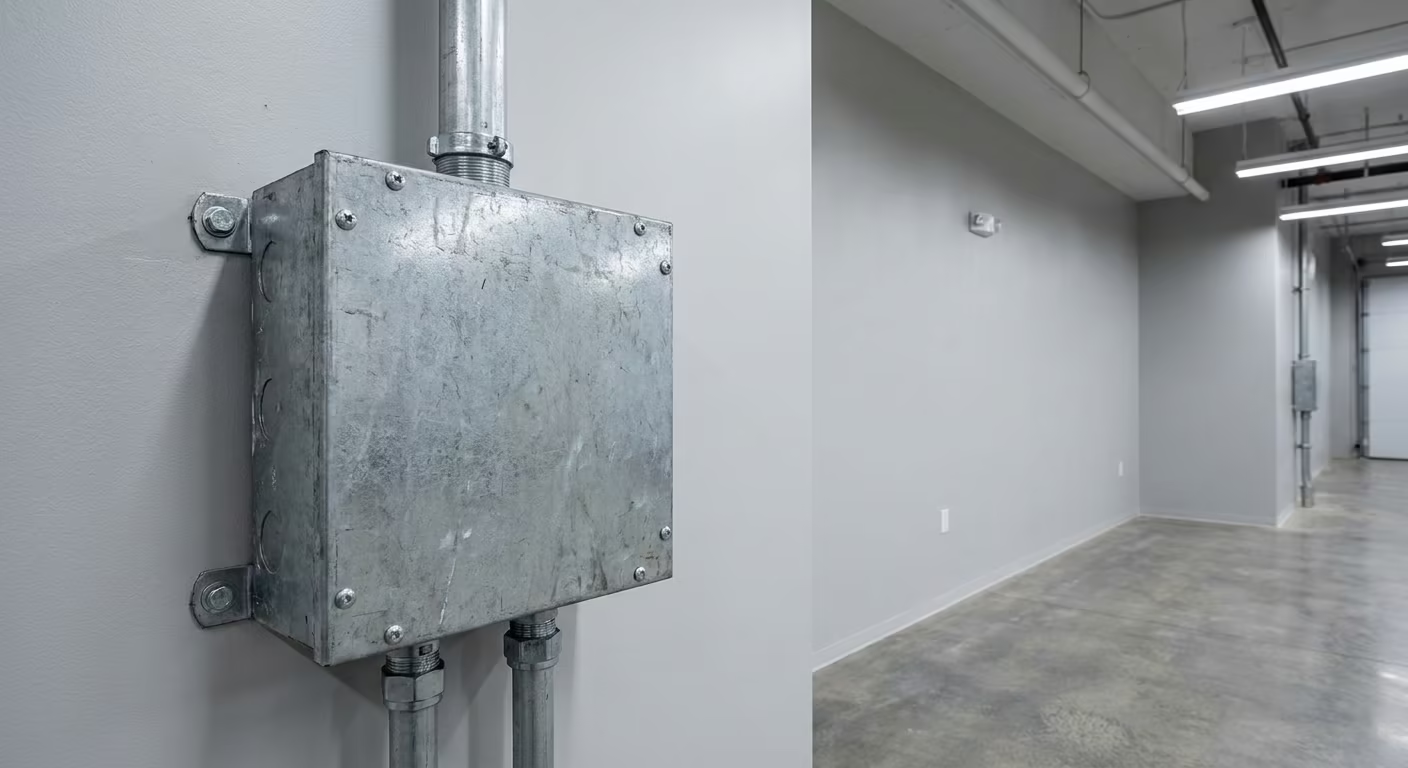
A minimum 1-inch EMT or 1-1/4-inch Schedule 40 PVC is highly recommended for dual 50A or 60A circuits to maintain code compliance and ease of installation.
NEC 310.15(C)(1): The 80% Ampacity Derating Rule
When current flows through a wire, it generates heat. When multiple wires generate heat inside the same enclosed pipe, that heat compounds. NEC Table 310.15(C)(1) requires you to derate (reduce) the allowable ampacity of conductors when 4 or more current-carrying conductors are in a single raceway.
For 4 to 6 current-carrying conductors (two EV chargers require exactly 4 hot conductors), you must apply an 80% adjustment factor. Fortunately, THHN wire allows you to apply this 80% multiplier against its 90°C ampacity rating, even if you are ultimately limited to the 75°C column for terminations.
- 6 AWG THHN (90°C baseline): Rated at 75 Amps.
- 80% Derating Applied: $75text{A} times 0.80 = 60text{ Amps}$.
Because the derated value (60A) meets the required 60A breaker size, you can safely run two sets of 6 AWG THHN conductors in the same pipe for dual 48A chargers without needing to upsize the wire to 4 AWG.
Frequently Asked Questions
Q: Does the ground wire count as a current-carrying conductor for derating?
A: No. Under NEC 310.15(E), equipment grounding conductors are not considered current-carrying and do not trigger ampacity derating penalties, though they still count toward physical conduit fill limits.
Q: Can I share a single neutral wire for two EV chargers?
A: Hardwired EV chargers generally operate purely on 240V and do not use a neutral. If your specific EVSE requires 120V logic power, you must run individual neutrals for each circuit or utilize a properly sized multi-wire branch circuit (MWBC) configured with a common trip breaker.
Securing Your Electrical Conduits & Cables?
Keep your electrical installations neat and code-compliant. Check out our parametric conduit clamps and cable organizers, custom-engineered and 3D printed in rugged industrial PETG.