

Wire Sizing for RV & Marine DC-DC Battery Chargers (Alternator to Lithium)
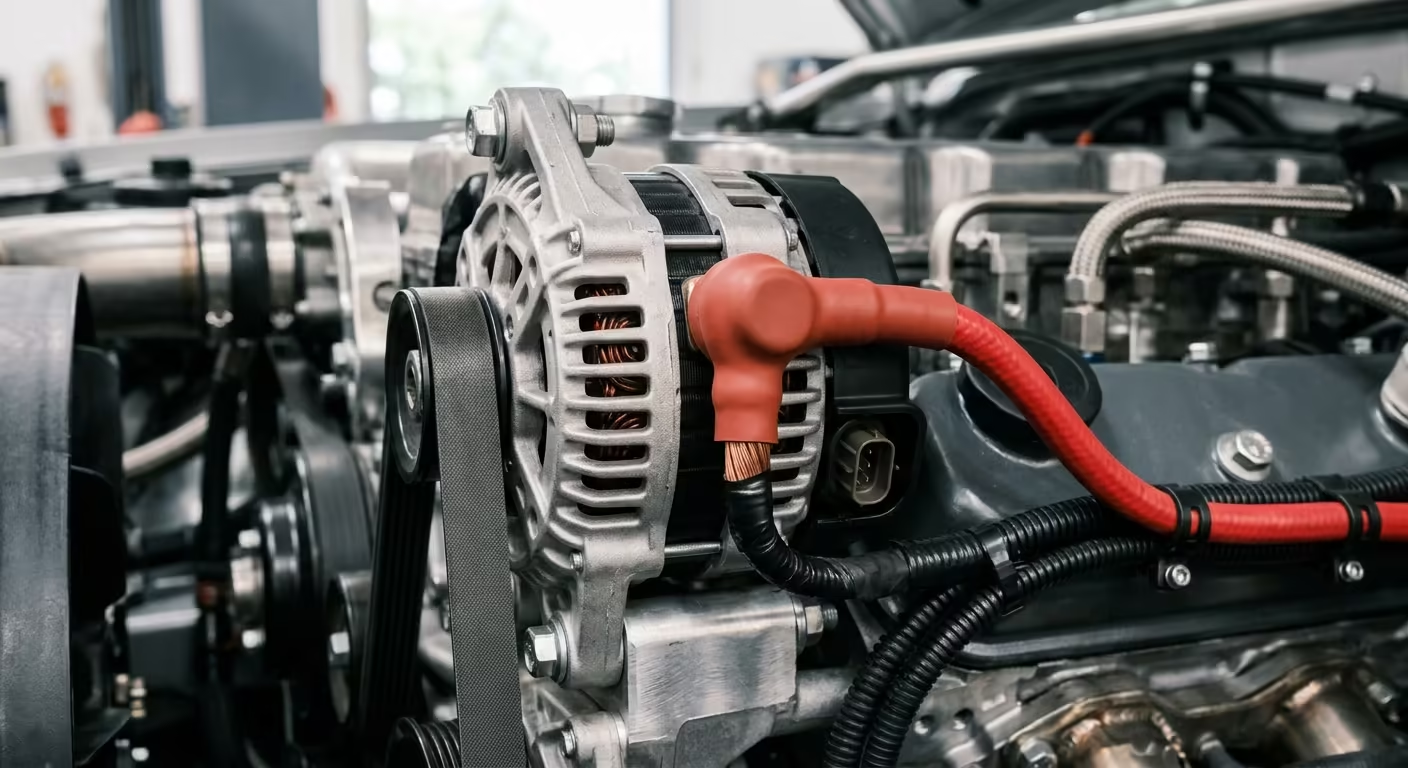
Upgrading a marine vessel or RV house bank to Lithium Iron Phosphate (LiFePO4) drastically improves energy storage, but it introduces a fatal threat to the vehicle’s alternator. Unlike lead-acid batteries, lithium batteries have negligible internal resistance and will absorb as much current as the charging source can produce. If connected directly via a traditional smart relay or isolator, a depleted lithium bank will force a standard alternator to run at 100% capacity continuously, causing it to rapidly overheat and burn out its internal diodes.
A DC-to-DC (DC-DC) battery charger solves this by throttling the amperage drawn from the alternator (e.g., to a safe 30A or 40A continuous) while delivering a tailored multi-stage charge profile to the lithium bank. However, pulling 40 to 60 continuous amps from the engine bay to a house bank located 15 to 25 feet away in an RV or boat creates massive electrical resistance. Sizing these long conductor runs requires strict adherence to ABYC 3% voltage drop standards to ensure the charger receives sufficient input voltage to activate and operate efficiently.
Need Exact Wire Sizing for Your Charging Circuit?
Input your DC-DC charger’s maximum amp rating and the round-trip distance to the alternator to calculate the ABYC-compliant AWG.
In This Guide:
Voltage Drop Rules: Input Side vs. Output Side
When installing a DC-DC charger, the circuit is physically divided into two distinct wire runs: the Input Circuit (from the starter battery/alternator to the charger) and the Output Circuit (from the charger to the house battery bank).
- Input Side Voltage Drop: Most DC-DC chargers use voltage-sensing to turn on (e.g., activating when they sense the alternator hitting 13.5V). If the input wire from the engine bay is undersized, pulling 40A over 20 feet will cause voltage to crash at the charger’s terminals. If the voltage drops below the trigger threshold (e.g., 12.8V), the charger will rapidly cycle on and off in an endless loop. A strict 3% voltage drop must be enforced on the input side.
- Output Side Voltage Drop: The output side carries the tailored bulk/absorption voltage to the lithium bank. To ensure the house batteries reach a full 14.4V or 14.6V 100% State of Charge (SoC), the output conductors must also be sized for a maximum 3% drop. Fortunately, it is best practice to mount the charger within 3 to 5 feet of the house battery, making the output run very short and easy to cable.
Calculating Circular Mils for Long DC-DC Runs
To determine the exact conductor size needed to keep voltage drop under 3% (0.36V on a 12V nominal system), use the ABYC Circular Mils equation. Remember that the distance ($L$) is the Total Round-Trip Distance.
CM = (10.75 × I × L) / ΔV
Example Calculation: You are installing a 40A DC-DC charger in a campervan. The distance from the starter battery to the charger is 20 feet (40 feet round-trip). The charger actually pulls roughly 10% more power on the input side to account for conversion losses, so we calculate for 44 Amps of input current.
CM = (10.75 × 44A × 40ft) / 0.36VCM = 18,920 / 0.36 = 52,555 Circular Mils
A 4 AWG cable provides 41,740 CM (too small, resulting in a drop > 3%). You must step up to 2 AWG tinned copper (66,360 CM) to safely meet the 3% target and prevent the charger from short-cycling.
The Dual Fusing Requirement for Bi-Directional Faults
A critical safety oversight in DIY campervan and marine DC-DC installations is failing to fuse the input run from both ends. The thick cable running from the engine bay to the rear house bank connects two massive power sources: the starter battery and the lithium house battery.
If the insulation on that long 2 AWG cable chafes against the vehicle chassis halfway down the run and creates a dead short to ground, current will rush into the short from both directions. To prevent a catastrophic fire, you must install:
- A fuse at the starter battery (within 7 inches of the positive terminal) sized roughly 1.25x to 1.5x the charger’s max input draw.
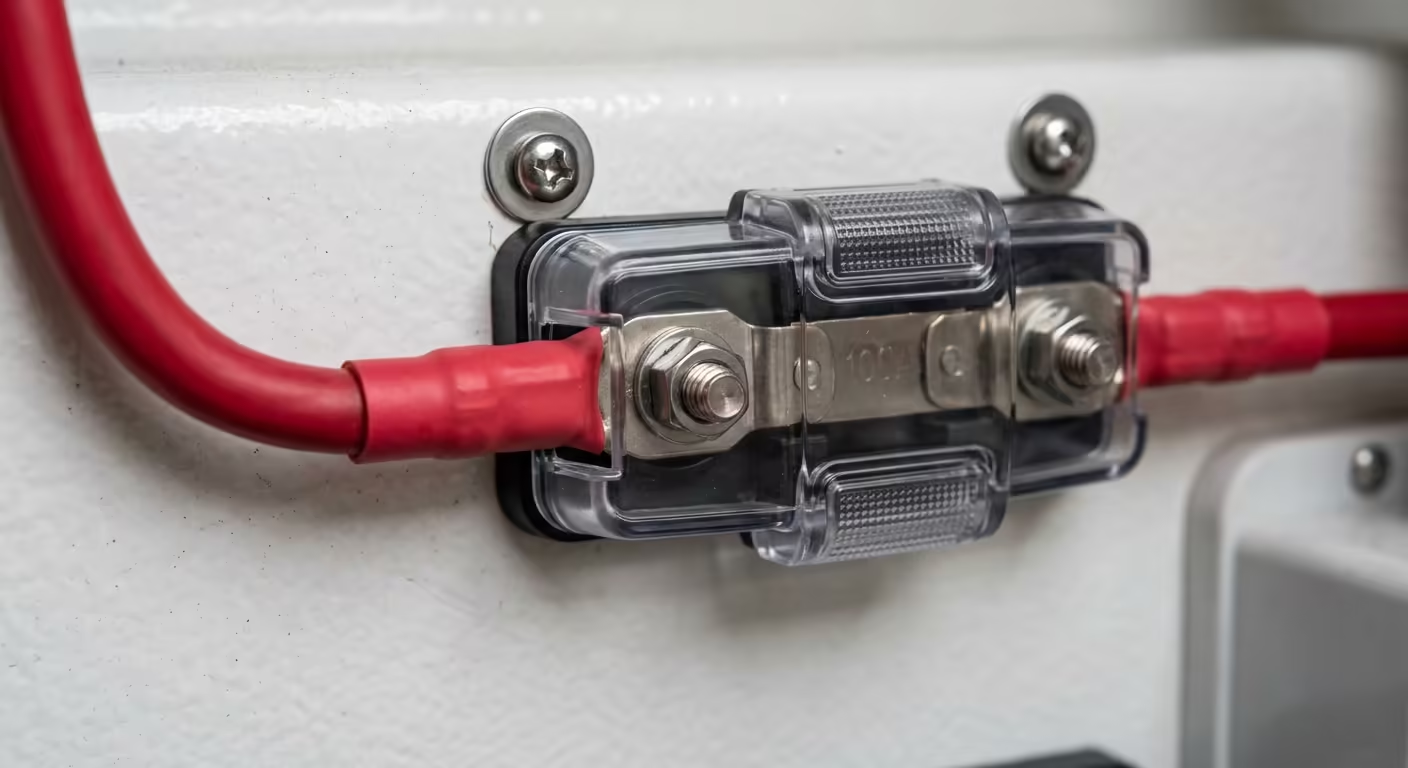
- A fuse at the house battery bank (protecting the charger’s output run) to prevent the lithium bank from dumping thousands of amps backward into a shorted charger. MIDI or MEGA fuses are ideal for this application.
DC-DC Charger Wire Sizing Reference Matrix
The table below provides minimum recommended UL 1426 Tinned Copper AWG sizes for the input run of common 12V DC-DC chargers, targeting a strict 3% voltage drop. (Distances listed are One-Way from starter battery to charger; the math natively accounts for the round trip).
| Charger Size (Output) | Max Input Draw (~10% Loss) | 10 ft One-Way Run | 15 ft One-Way Run | 20 ft One-Way Run |
|---|---|---|---|---|
| 18A / 20A | 25 Amps | 8 AWG | 6 AWG | 4 AWG |
| 30A | 35 Amps | 6 AWG | 4 AWG | 2 AWG |
| 40A | 45 Amps | 6 AWG | 4 AWG | 2 AWG |
| 50A / 60A | 65 Amps | 4 AWG | 2 AWG | 1 AWG |
*Note: Using the vehicle’s steel chassis as the negative return path creates unpredictable resistance and encourages galvanic corrosion. For marine and fiberglass RV applications, you must run a dedicated negative copper cable the entire distance back to the starter battery.
Frequently Asked Questions
Q: Can I use standard automotive wire instead of marine tinned copper for my campervan?
A: It is highly discouraged. Automotive wire uses bare copper strands that oxidize over time, increasing electrical resistance. UL 1426 Marine Grade Tinned Copper wire (Class K stranding) resists corrosion and handles the constant road vibration of an RV far better than stiff automotive wire.
Q: My alternator is rated for 150 Amps; can I safely install a 60A DC-DC charger?
A: Generally, no. A 150A alternator is rated for peak intermittent output at high RPMs. At idle, it may only produce 60A to 80A. If the DC-DC charger pulls 60A continuously while you are idling in traffic with the AC and headlights on, the alternator will overheat and fail. A safe rule of thumb is to size your DC-DC charger at no more than 30% to 50% of the alternator’s maximum rated output.
Q: Where should the DC-DC charger be physically mounted?
A: Mount the DC-DC charger as close to the house battery bank as possible (typically within 3 to 5 feet). This keeps the output wiring short, ensuring that the precision bulk and absorption voltages generated by the charger reach the lithium batteries without any voltage drop interference.
Securing Your Marine & RV Cables?
Keep your electrical installations neat and code-compliant. Check out our parametric conduit clamps and marine cable organizers, custom-engineered and 3D printed in rugged industrial PETG.
