
Wire Gauge for 40A NEMA 14-50 EV Charging Receptacle
The NEMA 14-50 receptacle is the most common 240V plug-in outlet used for Level 2 electric vehicle charging in North America. Rated for a nominal 50 amps at 120/240 volts, this 4-prong socket supplies mobile charging cords and plug-in EVSE wall units with up to 9.6 kW of power. However, wiring a NEMA 14-50 outlet specifically for electric vehicle service requires different thermal margins and hardware specifications than wiring the same outlet for an intermittent household appliance like an electric range.
Under National Electrical Code (NEC) Article 625, electric vehicle charging is classified as a continuous load. This rule restricts sustained charging current to exactly 80% of the circuit rating (40A on a 50A breaker) and requires dedicated conductor sizing across all four conductors to prevent nuisance tripping, insulation breakdown, and receptacle terminal melting.
Planning Your NEMA 14-50 Circuit Run?
Calculate conductor gauge, conduit fill limits, and distance-based voltage drop for your Level 2 plug-in charging setup.
In This Guide:
The 80% Continuous Rule: 40A Draw on a 50A Breaker
NEC Article 100 defines a continuous load as any load where maximum current is expected to run uninterrupted for three hours or longer. Under NEC 210.19(A)(1) and NEC 625.42, branch circuit overcurrent protective devices (OCPD) and conductors must be rated for at least 125% of the continuous current:
40A Continuous EV Draw × 1.25 = 50A Circuit Breaker & Conductor Ampacity
Conversely, a standard 50-amp non-continuous breaker is permitted to sustain only 80% of its nominal faceplate value ($50text{A} times 0.80 = 40text{A}$). If an EV owner configures their vehicle or mobile charger to pull 48 amps through a NEMA 14-50 plug, the breaker’s bi-metallic thermal strip will overheat and trip within 30 to 90 minutes. A 48A continuous charge requires a 60A hardwired circuit and cannot legally or safely be run through a NEMA 14-50 outlet.
The 4-Wire Configuration: Why Neutral is Mandatory
Unlike hardwired EV chargers that operate strictly as pure 240V balanced loads (requiring only two hot lines and an equipment ground), a NEMA 14-50 receptacle is a 120/240V split-phase straight-blade configuration. Code requires four distinct conductors landed in the outlet box:
- Line 1 (Hot): Black insulated conductor ($120text{V}$ to ground)
- Line 2 (Hot): Red insulated conductor ($120text{V}$ to ground, $240text{V}$ phase-to-phase)
- Neutral: White insulated conductor (Center-tap neutral)
- Equipment Grounding Conductor (EGC): Bare copper or green insulated conductor
Even though most dedicated EV charging units ignore the neutral pin and only pull power across Line 1 and Line 2, NEC 406.4 mandates that every receptacle pin must be wired to its intended system conductor. Installing a 3-wire run to a 14-50 receptacle (bootlegging ground or leaving the neutral terminal floating) is a major code violation that creates a severe shock hazard if an RV or multi-voltage device is ever connected to the outlet.

Conductor Sizing: 6 AWG NM-B vs 6 AWG THHN Copper
When wiring a 50-amp branch circuit, electricians frequently choose between nonmetallic-sheathed cable (NM-B / Romex) and individual thermoplastic conductors (THHN/THWN-2) pulled through electrical metallic tubing (EMT) or PVC conduit. Evaluating these conductors under NEC Table 310.16 reveals an important distinction:
| Conductor & Cable Type | NEC Column | Allowable Ampacity | 50A Breaker Legal Status |
|---|---|---|---|
| 6/3 NM-B Copper (Romex) | 60°C Column (NEC 334.80) | 55 Amps | Compliant (55A > 50A Breaker) |
| 6 AWG Copper THHN in Conduit | 75°C Terminal Limit (NEC 110.14(C)) | 65 Amps | Compliant (High Thermal Headroom) |
| 8/3 NM-B Copper (Romex) | 60°C Column (NEC 334.80) | 40 Amps | Code Violation on 50A Breaker |
| 4 AWG Aluminum SER / XHHW-2 | 75°C Column (AL9CU Lugs) | 65 Amps | Compliant (Requires AL9CU Device) |
Per NEC 334.80, 6/3 NM-B copper is evaluated at the 60°C temperature rating, yielding an allowable ampacity of 55 amps. Because 55A meets and exceeds the 50A overcurrent protective device rating, 6/3 NM-B is compliant for a 50A breaker serving a 40A EV load. However, for surface-mounted garage raceways exposed to elevated ambient heat, pulling 6 AWG THHN copper conductors in 3/4-inch EMT provides 65A ampacity at 75°C terminals, minimizing thermal rise over extended charging sessions.
Industrial vs Residential Receptacles (Preventing Melting)
One of the most documented failure modes in home Level 2 EV charging is the thermal destruction and melting of residential-grade NEMA 14-50 receptacles. Standard $10–$15 residential outlets (commonly engineered for electric kitchen stoves) are designed for intermittent duty cycles where 30–40 amps are drawn for only 20 to 45 minutes at a time.
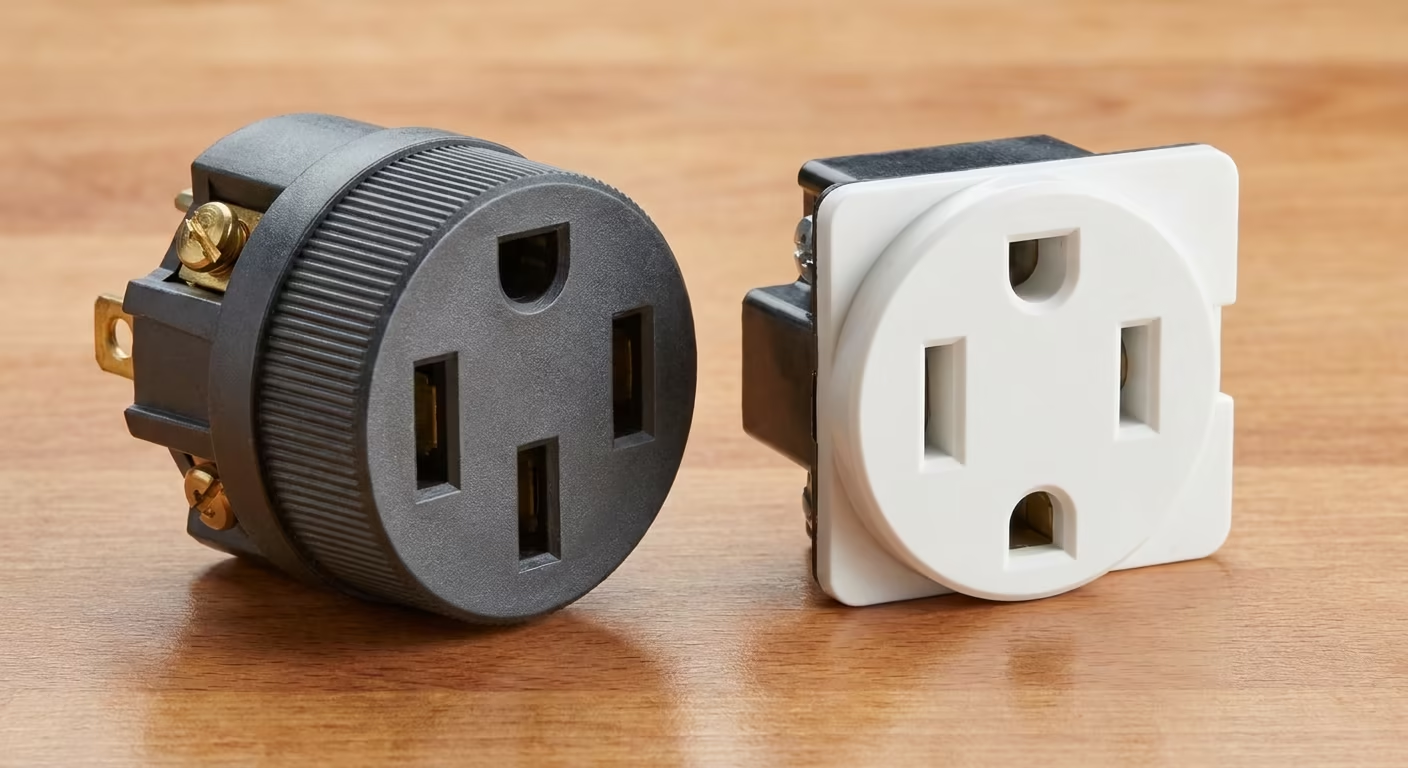
When an EVSE draws 40 amps continuously for 6 to 10 hours overnight, light-duty spring-metal leaf contacts in cheap receptacles lose spring tension due to thermal cycling. This creates high-resistance contact points, causing temperatures to exceed 200°F (93°C), charring the receptacle face and melting the plug housing.
To ensure long-term safety, always specify a commercial/industrial-grade receptacle such as the Hubbell HBL9450A or Bryant 9450FR. These units feature:
- Heavy solid brass contact jaws with high retention force that grip plug blades tightly.
- Substantial brass screw clamping pressure plates that do not nick or deform stranded 6 AWG wire.
- High-impact, glass-reinforced thermoplastic bodies rated for severe thermal stress up to 105°C.
- Accurate torque ratings ($75text{ in-lbs}$) calibrated to prevent loose terminal arcing.
Mathematical Voltage Drop Calculations (25 ft to 150 ft)
Maintaining delivered voltage within 3% under continuous load preserves charging speed and prevents EV onboard charger derating. The standard single-phase voltage drop formula is:
ΔV = (2 × K × I × L) / CM
Where:
- K: Direct current constant of resistivity for copper ($12.9text{ ohms-cmil/ft}$)
- I: Continuous load current ($40text{ Amps}$)
- L: One-way circuit distance in feet
- CM: Conductor cross-sectional area (6 AWG = $26,240text{ CM}$; 4 AWG = $41,740text{ CM}$)
Calculating the performance across common circuit distances on 6 AWG copper conductors at 240V:
- At 25 Feet (Standard Garage Installation):
ΔV = (2 × 12.9 × 40 × 25) / 26,240 = 25,800 / 26,240 = 0.98V
Voltage Drop: 0.41% (Optimal performance; negligible heat dissipation). - At 75 Feet (Basement to Detached Bay):
ΔV = (2 × 12.9 × 40 × 75) / 26,240 = 77,400 / 26,240 = 2.95V
Voltage Drop: 1.23% (Well under the recommended 3.0% threshold). - At 150 Feet (Long Trench or Subpanel Feeder Run):
ΔV = (2 × 12.9 × 40 × 150) / 26,240 = 154,800 / 26,240 = 5.90V
Voltage Drop: 2.46% (Acceptable, but nearing 3% boundary).
On runs extending beyond 150 feet, upsizing conductors to 4 AWG copper (yielding a drop of only 1.55% / 3.71V at 150 ft) is recommended to prevent inductive voltage sag and minimize long-term energy loss.
Frequently Asked Questions
Q: What size breaker is required for a NEMA 14-50 EV receptacle?
A: A standard NEMA 14-50 receptacle is installed on a 50-amp, 2-pole circuit breaker. Under the continuous load rule (NEC 625.42), the connected EVSE must be set to pull no more than 40 amps continuously ($40text{A} times 1.25 = 50text{A}$).
Q: Does NEC 2020 or 2023 require a GFCI breaker for a NEMA 14-50 outlet?
A: Yes. NEC 210.8(A) and NEC 625.54 require all 150V-to-ground or higher receptacles installed in garages, outdoors, and utility areas to have Class A GFCI protection at the breaker. Note that because portable EV charging cords have their own built-in internal GFCI monitoring circuitry, nuisance tripping (“double GFCI tripping”) can occasionally occur.
Q: Can I use 8 AWG wire for a NEMA 14-50 receptacle on a 50A breaker?
A: No, not with standard NM-B Romex. Per NEC Table 310.16 and NEC 334.80, 8 AWG NM-B is restricted to the 60°C ampacity column at 40 amps, which cannot legally be protected by a 50A breaker. While 8 AWG copper THHN in conduit is rated for 50 amps at 75°C terminals, it leaves zero safety margin for continuous EV loads. 6 AWG copper is the industry standard minimum.
Q: What size equipment ground wire is required for a 50A NEMA 14-50 circuit?
A: Per NEC Table 250.122, a 50-amp overcurrent protection device requires a minimum 10 AWG copper (or 8 AWG aluminum) equipment grounding conductor.
Securing Your Electrical Conduits & Cables?
Keep your electrical installations neat and code-compliant. Check out our parametric conduit clamps and cable organizers, custom-engineered and 3D printed in rugged industrial PETG.