
Hardwired vs Plug-In EVSE: Conductor Sizing & NEC Rules
When installing a Level 2 Electric Vehicle Supply Equipment (EVSE) station, you must decide between two primary connection methods: a hardwired direct terminal connection, or a plug-in installation utilizing a 240V wall receptacle (most commonly a NEMA 14-50). While both provide excellent charging capabilities, the National Electrical Code (NEC) treats them differently regarding maximum allowable amperage, conductor requirements, and GFCI safety implementation.
Ready to Size Your Wire Gauge?
Select your continuous amperage and circuit type to calculate the correct NEC-compliant wire size instantly.
In This Guide:
Maximum Amperage Limits: 40A Plug vs 48A+ Hardwire
Under NEC 625 continuous load constraints, a plug-in NEMA 14-50 receptacle (rated for 50 amps) can only legally support a maximum continuous charging draw of 40 amps. If your vehicle supports 48-amp (11.5 kW) or 80-amp (19.2 kW) fast AC charging, you cannot utilize a plug-in outlet; you are required to hardwire the station.
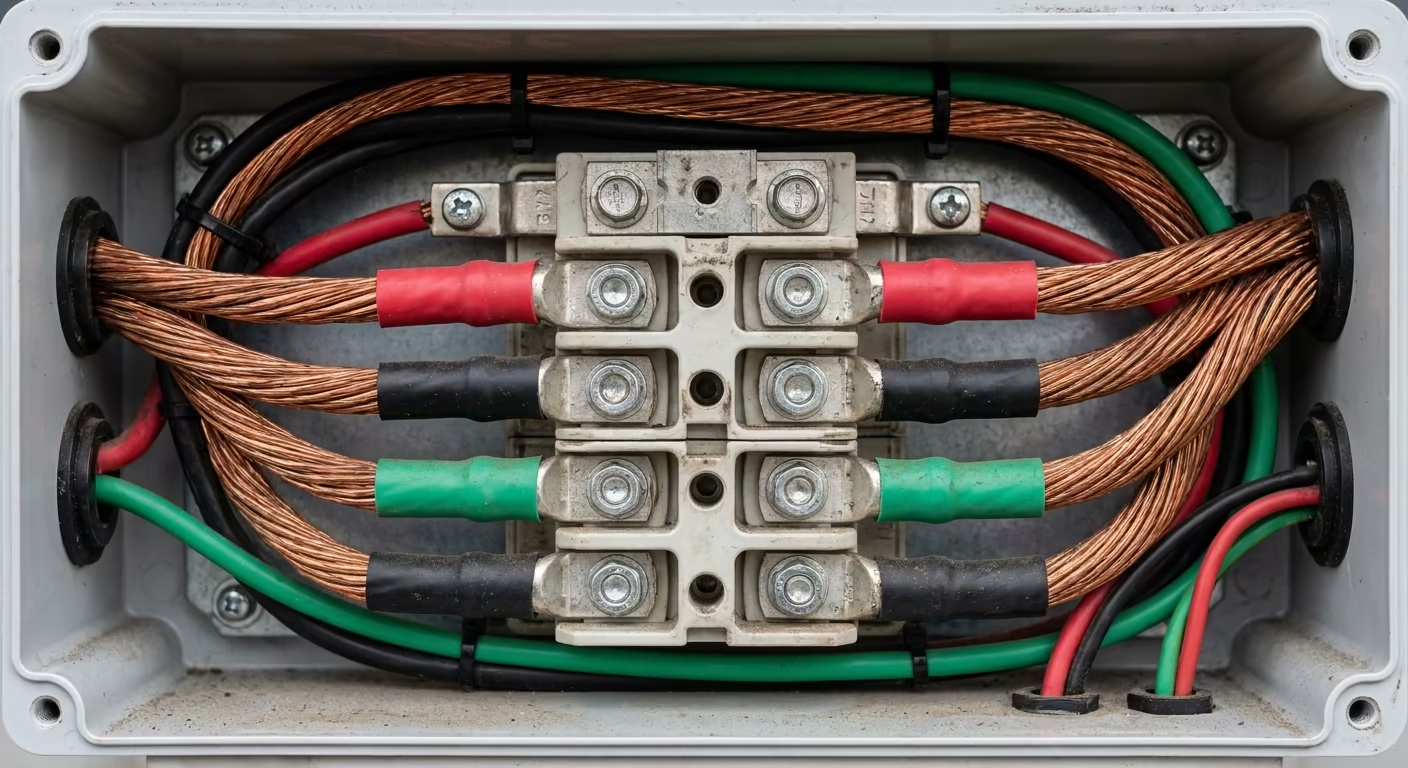
Hardwiring allows you to dedicate a 60A or 100A branch circuit directly to the EVSE. For a 48A continuous charge, you bypass the receptacle entirely, pulling 6 AWG THHN copper in conduit directly to the charger’s internal terminal clamping blocks.
NEC 625.54: GFCI Breakers & Nuisance Tripping
As of the 2020 and 2023 NEC cycles, Article 625.54 requires that all 150V-to-ground or higher receptacles installed in garages and outdoor spaces possess Ground-Fault Circuit Interrupter (GFCI) protection at the breaker panel.

This creates a conflict: modern Level 2 chargers contain their own internal, highly sensitive ground-fault monitoring circuitry. When you plug a smart charger into a GFCI-protected NEMA 14-50 receptacle, the two ground-fault systems interfere with each other, frequently causing “double GFCI nuisance tripping” that abruptly stops charging sessions overnight.
The Solution: The NEC does not require GFCI breakers for hardwired appliances. By hardwiring your EVSE, you eliminate the need for a GFCI breaker, relying entirely on the charger’s built-in safety mechanisms and ensuring uninterrupted charging.
Thermal Reliability: Eliminating the Failure Point
Every mechanical connection in an electrical circuit is a point of resistance. In a plug-in setup, current flows from the breaker, into the receptacle lugs, across the tensioned metal receptacle jaws, into the plug blades, and finally into the charger cord. Over months of heavy thermal cycling, the metal jaws inside standard residential grade receptacles relax.

Hardwiring removes the receptacle from the equation entirely.
Frequently Asked Questions
Q: Can I use stranded wire for a hardwired EV charger?
A: Yes, provided the charger’s terminal block is rated for stranded wire. Most premium units accept both solid and stranded copper.
Q: Does a hardwired charger need a neutral wire?
A: No. A hardwired EVSE runs purely on 240V and only requires three wires (Line 1, Line 2, and Ground), avoiding the need for a neutral conductor.
Securing Your Electrical Conduits & Cables?
Keep your electrical installations neat and code-compliant. Check out our parametric conduit clamps and cable organizers, custom-engineered and 3D printed in rugged industrial PETG.