
Sizing Aluminum Feeders for a 50A EV Subpanel: Code Guide
When running a new 50-amp circuit from a main house panel to a garage or parking area for electric vehicle charging, the cost of thick copper conductors can be staggering. To drastically reduce material costs, electricians often install a local garage subpanel or disconnect switch fed by aluminum conductors (such as SER or URD cable) before transitioning to copper for the final connection to the EV charger.
While modern aluminum alloys (AA-8000 series) are exceptionally safe and reliable, utilizing them requires strict adherence to NEC sizing charts, dual-rated terminal lug compatibility, and precise mechanical torque specifications to prevent thermal expansion failures.
Sizing Your Aluminum Feeder Run?
Switch between copper and aluminum in our calculator to find the exact gauge needed for your 50A subpanel.
In This Guide:
Sizing the Cable: #4 AWG Aluminum SER
Because aluminum is inherently more resistive than copper, you must upsize the gauge to safely carry the same amperage. For a dedicated 50-amp feeder circuit (supporting a 40A continuous EV load), you must consult NEC Table 310.16.
Under the 75°C allowable ampacity column, #4 AWG Aluminum is rated for 65 amps. This provides ample thermal headroom to continuously supply a 50A subpanel. Running #4 AWG Aluminum SER cable is often less than half the cost of running the equivalent #6 AWG Copper Romex, making it the preferred choice for distances over 40 feet.
The EVSE Terminal Restriction & AL9CU Lugs
The most critical rule of using aluminum for EV charging is understanding equipment limits. Almost all EVSE terminal blocks are rated strictly for copper conductors. You cannot land an aluminum wire directly into a Tesla Wall Connector, ChargePoint, or standard NEMA 14-50 receptacle.

From this subpanel, you then run a short “whip” of #6 AWG copper wire from a 50A breaker directly to the EV charger’s copper-only terminals.
NEC 110.14(D) Torque Specs & Anti-Oxidants
Aluminum wire expands and contracts under heavy thermal loads more significantly than copper. Over time, this “cold flow” can cause connections to loosen, creating high-resistance arcing that melts panels.
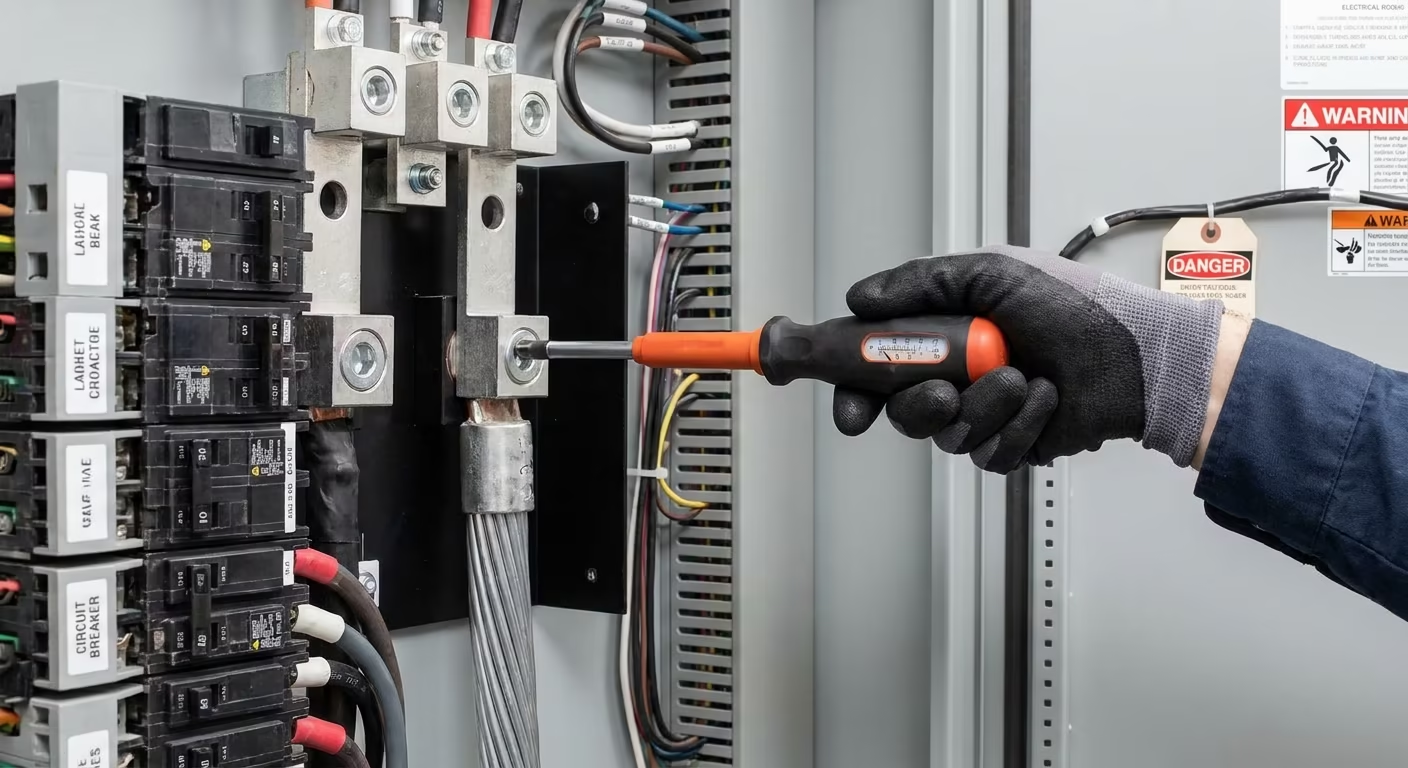
Guessing the torque by hand on an aluminum 50A feeder is a severe fire hazard. Additionally, when preparing the aluminum wire for termination, it is standard practice to coat the exposed strands with joint compound.

Frequently Asked Questions
Q: Can I use aluminum wire for a NEMA 14-50 EV receptacle?
A: No. NEMA 14-50 receptacles are generally rated for copper wire only. You must land the aluminum feeder in a subpanel or junction box first, then use mechanical Polaris connectors (rated AL9CU) to transition to copper wire for the final run to the receptacle.
Q: What size aluminum ground wire do I need for a 50A subpanel?
A: Per NEC Table 250.122, a 50-amp feeder requires a minimum 8 AWG aluminum equipment grounding conductor.
Securing Your Electrical Conduits & Cables?
Keep your electrical installations neat and code-compliant. Check out our parametric conduit clamps and cable organizers, custom-engineered and 3D printed in rugged industrial PETG.