
Sizing 80A Commercial Level 2 Chargers (Ford Charge Station Pro)
High-capacity battery architectures, such as those found in the Ford F-150 Lightning and commercial delivery fleets, utilize 80-amp AC Level 2 charging stations to fully replenish massive battery packs overnight. Delivering 19.2 kW of sustained power, units like the Ford Charge Station Pro are heavy-duty industrial appliances that push residential electrical infrastructure to its absolute limits.
Wiring an 80A EVSE requires strict adherence to NEC continuous load multipliers, heavy-gauge conductor selection, and specific integration strategies if the unit supports bidirectional vehicle-to-home (V2H) backup power.
Calculating High-Amperage Circuit Runs?
Compute precise conductor thickness for 100-amp continuous duty cycles to eliminate inductive voltage sag.
In This Guide:
The 100A Breaker Requirement
Because EV charging operates as a continuous load under NEC 625, the branch circuit must be sized at 125% of the unit’s maximum current draw.
80 Amps × 1.25 = 100 Amp Overcurrent Protection Device
An 80A charger requires a dedicated 100-amp double-pole breaker. For many homes with older 100A or 150A main services, this single appliance will trigger the need for a full heavy-up utility service upgrade to a 200A or 400A panel, or the implementation of an Automated Load Management System (ALMS).
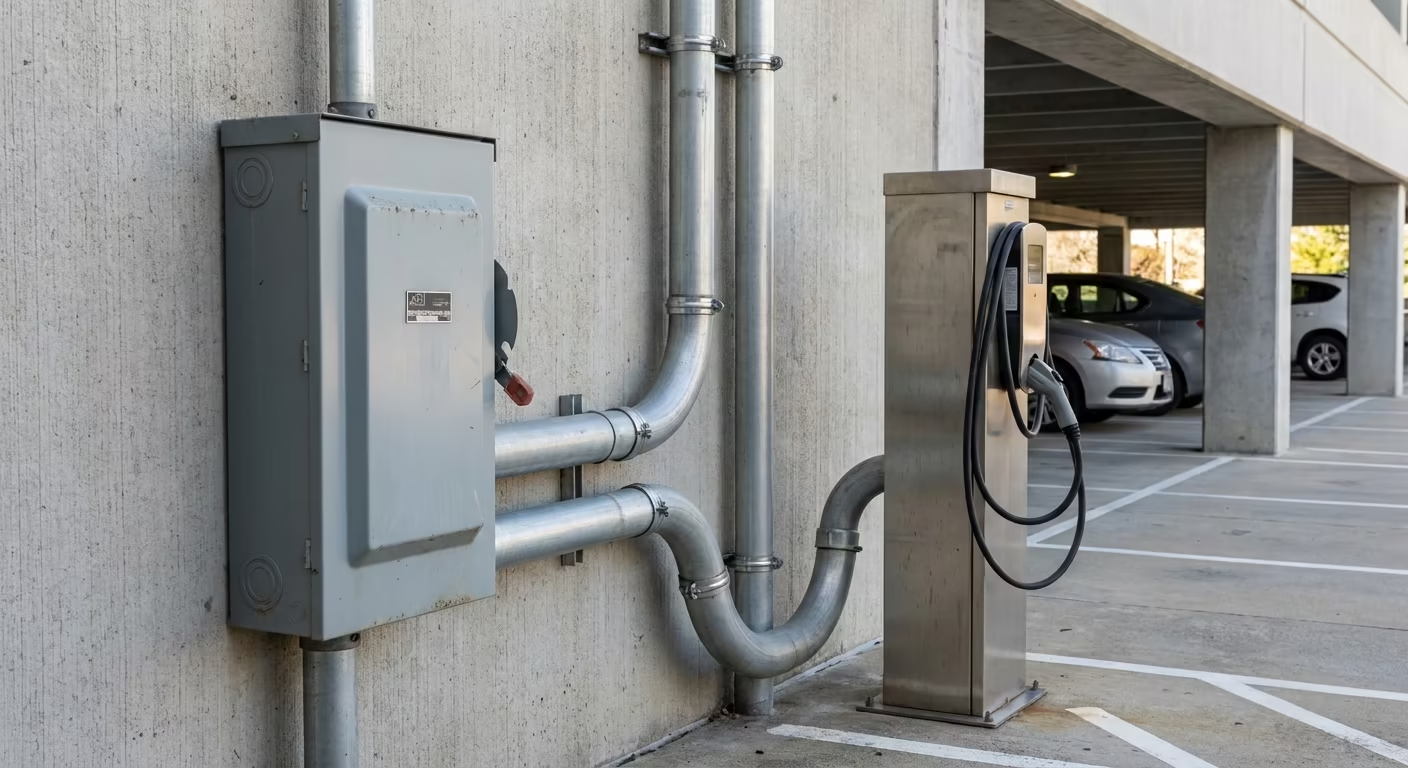
Conductor Sizing: 3 AWG vs 2 AWG Copper
To safely carry 100 amps, conductor gauge selection depends on the wiring material and ambient environment:
- 3 AWG THHN Copper: Rated for exactly 100A at 75°C. This is the absolute minimum gauge permitted for a 100A circuit in conduit.
- 2 AWG THHN Copper: Rated for 115A at 75°C. Up-sizing to 2 AWG is highly recommended for 80A chargers. It provides essential thermal headroom, reduces long-term resistive line losses, and minimizes voltage drop when the system reverses flow during bidirectional V2H operation.
If utilizing aluminum feeders to route power from a main panel to a local garage subpanel before stepping down to the charger, you must use a minimum of 1 AWG or 1/0 AWG Aluminum SER cable to safely sustain the 100A subpanel feed.
Bidirectional Charging Considerations
Chargers like the Ford Charge Station Pro double as residential backup inverters, taking high-voltage DC power from the truck’s battery, converting it to AC, and feeding it back into the home integration system. While drawing 80A to charge, it may push a slightly different current back during discharge. Your conductors, neutral pathways (if running to a transfer switch), and grounding infrastructure must be sized to support the maximum theoretical load in both directions flawlessly.
Frequently Asked Questions
Q: What size ground wire do I need for a 100-amp EV circuit?
A: Per NEC Table 250.122, a 100-amp overcurrent device requires a minimum 8 AWG copper or 6 AWG aluminum equipment grounding conductor.
Securing Your Electrical Conduits & Cables?
Keep your electrical installations neat and code-compliant. Check out our parametric conduit clamps and cable organizers, custom-engineered and 3D printed in rugged industrial PETG.