
Subpanel Wire Size Calculator
Running power to a detached garage, workshop, or basement addition requires installing a subpanel. Because subpanel feeders carry heavy loads over longer distances, sizing the feeder and grounding conductors correctly is critical to prevent dangerous voltage drops, overheating, and potential electrical fires.
Use our Subpanel Wire Size Calculator below to instantly determine the correct feeder wire gauge (Copper or Aluminum) based on your breaker amperage and total run distance, strictly following National Electrical Code (NEC) standards.
Recommended Minimum Feeder Size:
Comprehensive Guide to Subpanel Feeder Sizing
When planning an electrical expansion—such as powering a detached workshop, a backyard shed, a large garage, or an in-law suite—installing a subpanel is almost always required. However, unlike standard branch circuits inside a home, subpanel feeders require managing significantly higher amperage loads over extended physical runs.
To ensure total compliance with the National Electrical Code (NEC), you must evaluate three core variables: total breaker ampacity, conductor material (Copper vs. Aluminum), and total one-way distance. Failing to account for distance can lead to severe voltage drop, causing motorized equipment to overheat and electronics to malfunction.
Wiring a Subpanel: The Mandatory 4-Wire System
Modern NEC regulations mandate that all subpanels supplied from a separate building or detached structure must utilize a 4-wire feed system. This setup consists of:
- Two Hot Conductors: Delivering balanced 240V split-phase power.
- One Neutral Conductor: Handling unbalanced 120V loads.
- One Dedicated Equipment Grounding Conductor (EGC): Providing a safe, low-impedance path back to the main service panel earth ground.
Critical Rule: Separate Neutral and Ground Bars
One of the most common inspection failures in subpanel installations involves grounding and bonding. Unlike your main service entrance panel where the neutral and ground are bonded together, neutral and ground bars must remain completely isolated inside a subpanel.
The neutral bar floats on insulated standoffs, while the equipment grounding bar is bolted directly to the metal enclosure and bonded to the earth grounding electrodes (such as ground rods or concrete-encased electrodes). Failing to keep them separate creates parallel paths for return current, which introduces serious safety hazards.
Copper vs. Aluminum Conductors for Subpanels
When selecting wire material for high-amperage feeds (such as 100A or 200A services), budget and physical flexibility become major factors:
- Copper (THHN/XHHW/SER): Offers higher ampacity per gauge size and is less prone to oxidation, making it easier to terminate in tight spaces. However, it is significantly more expensive in large gauges.
- Aluminum (URD/THHN/SER): Far more cost-effective for long underground or overhead runs. Because aluminum has higher electrical resistance than copper, you must step up one or two gauge sizes (e.g., using 2/0 Aluminum instead of 1 Copper for a 100A feed) to match equivalent ampacity and voltage drop performance.
Routing Heavy Feeder Cables?
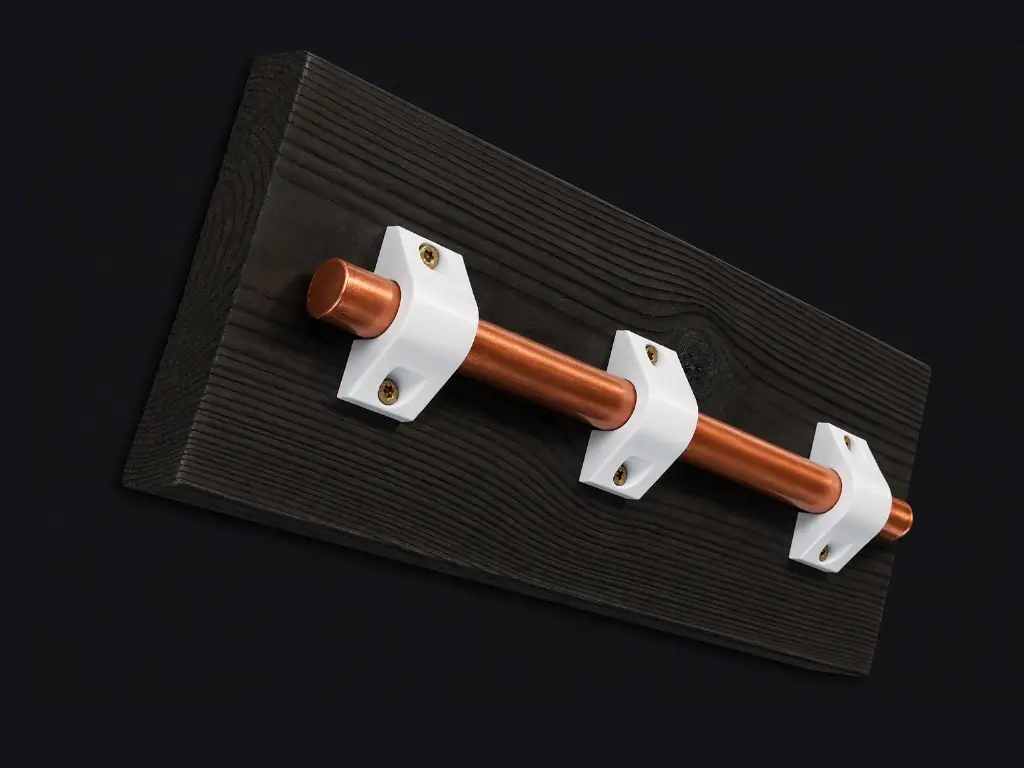
Subpanel feeder lines (like 2/0 SER) are rigid, heavy, and notoriously difficult to secure cleanly against studs or joists. Check out our parametric heavy-duty cable cleats, custom-fit to the exact diameter for your specific cable and ready to 3D print in durable PETG.