
Wire Size for 50 Amp RV Shore Power Hookups
Unlike a standard 30 Amp RV plug which supplies a single 120V feed, a 50 Amp RV shore power connection (NEMA 14-50R) is a completely different beast. It operates as a 120/240V split-phase system, providing two separate 50-amp, 120-volt legs. This gives a large RV up to 12,000 watts of available power—enough to run multiple air conditioners, a water heater, and a microwave simultaneously without tripping a breaker.
Because of this massive power capacity, the wiring feeding your RV pedestal or home hookup must be meticulously sized to handle continuous heavy loads and combat voltage drop over long yard or dock distances. Installing undersized wire for a 50A RV pedestal will lead to overheating terminals, melted plugs, and costly damage to the sensitive control boards inside the RV’s appliances.
Planning a Long Trench Run for Your RV Pad?
Calculate the exact wire gauge needed to prevent voltage drop from destroying your RV’s air conditioning compressors.
In This Guide:
Understanding the 4-Wire 120/240V System
A 50A RV pedestal requires a dedicated 4-wire feed from the main breaker panel. Do not attempt to wire this with 3-wire Romex; doing so violates the National Electrical Code (NEC) and creates a severe shock hazard by bonding neutral and ground in the wrong location.
- Line 1 (Hot): Usually black wire, carries 120V (50 Amps max).
- Line 2 (Hot): Usually red wire, carries 120V (50 Amps max).
- Neutral: White wire, carries the unbalanced return current.
- Ground: Bare copper or green wire, acts as the safety path for faults.
Baseline Wire Size: 6 AWG Copper
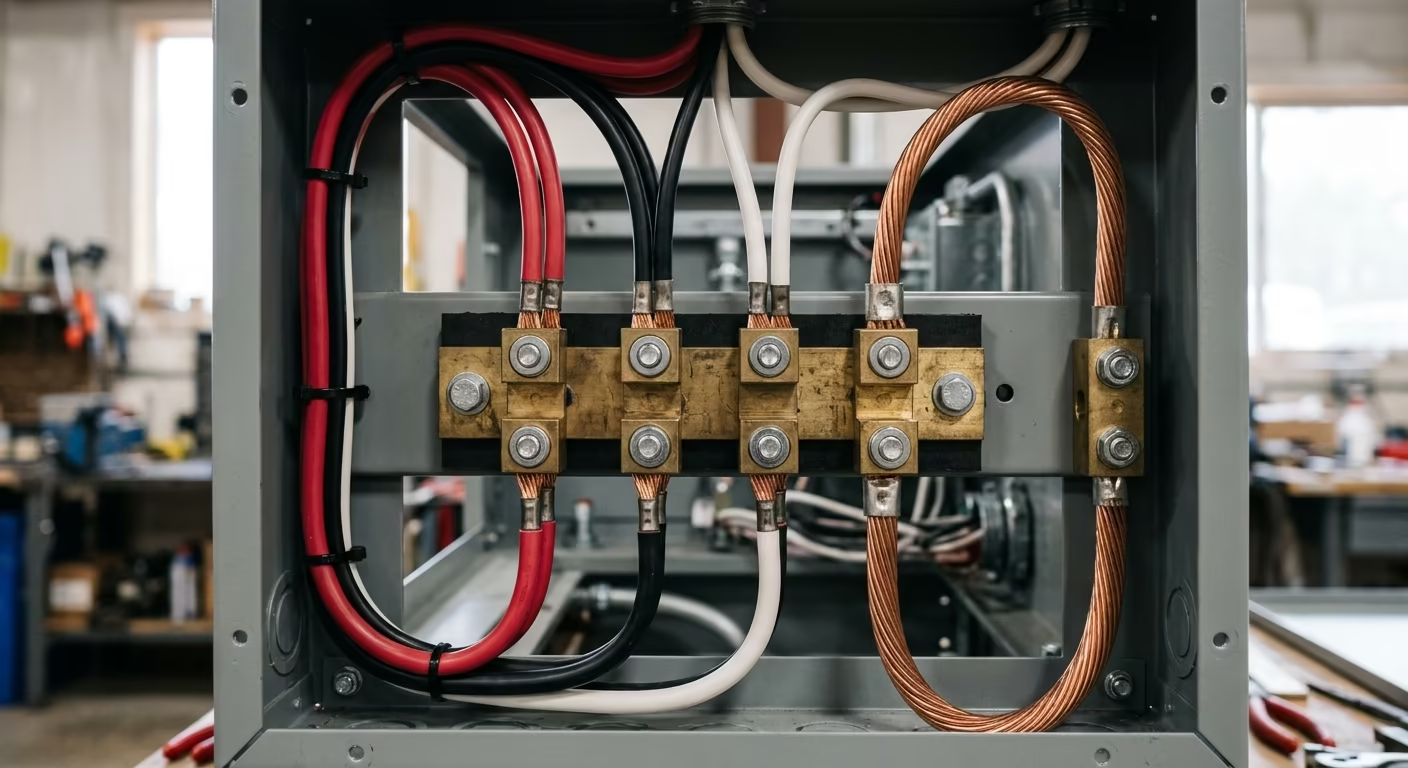
Under the NEC, standard THHN or THWN-2 copper wire run in conduit requires 6 AWG conductors to safely carry 50 amps. The ground wire can typically be downsized to 10 AWG copper for a 50A circuit, though many pre-made multi-conductor cables (like 6/3 UF-B for direct burial) will bundle an 8 AWG or 10 AWG ground internally.
If you are routing the wire underground to a detached pedestal, you must use wire rated for wet locations. Standard NM-B (Romex) is strictly prohibited in underground conduits, even if the conduit is completely sealed, because buried conduits are legally classified as wet locations.
Upsizing for Distance: The 3% Voltage Drop Rule
While 6 AWG copper can handle the amperage, it cannot push that amperage over long distances without experiencing voltage drop. RV air conditioners are notoriously sensitive to low voltage; if the voltage sags below 108V, the compressor motors will draw excessive current, overheat, and eventually seize.
To protect your RV, the wire must be sized to keep voltage drop under 3% (or roughly 3.6V on a 120V leg). Here is how you must upsize copper wire based on the distance from your main panel to the RV pedestal:
| One-Way Distance | Required Copper Gauge | Required Aluminum Gauge |
|---|---|---|
| Up to 75 Feet | 6 AWG | 4 AWG |
| 75 – 120 Feet | 4 AWG | 2 AWG |
| 120 – 180 Feet | 2 AWG | 1/0 AWG |
Can I Use Aluminum Wire?
Yes. Because long copper runs are extremely expensive, many installers use Mobile Home Feeder (MHF) or standard THWN-2 aluminum wire. If you use aluminum, you must step up the wire size to account for its higher resistance. A 50A circuit requires a baseline of 4 AWG Aluminum.
However, before pulling aluminum, verify that your 50A receptacle is marked AL9CU or CO/ALR, meaning it is dual-rated for both copper and aluminum. If the receptacle is only rated for copper, you must use mechanical splice blocks or insulated Polaris lugs inside the pedestal to transition the aluminum wire to short copper pigtails before landing on the receptacle terminals.
Clean Up Your Shore Power Cords?
Keep your heavy 50A RV shore power cords off the dirt and protected from water damage. Check out our parametric heavy-duty cable hangers, custom-engineered for 3D printing in rugged PETG or ABS.