
Sizing 24V & 36V Lithium Battery Cables for Marine Applications
Upgrading to 24V or 36V Lithium Iron Phosphate (LiFePO4) battery banks is the ultimate power enhancement for marine trolling motors and heavy-duty inverters. Unlike traditional lead-acid batteries that suffer from severe voltage sag under load, lithium batteries deliver a flat, sustained discharge curve. This means they can force your electrical conductors to carry high continuous current for extended durations without the natural “throttling” effect of voltage drop.
To safely harness this continuous power without risking insulation failure, voltage bottlenecking, or onboard fires, marine cabling must adhere strictly to the American Boat and Yacht Council (ABYC) E-11 standards. Sizing the correct tinned copper battery cables involves calculating the peak current draw of your 24V or 36V system, accounting for the entire round-trip circuit length, and ensuring the voltage drop remains under the critical 3% to 10% threshold.
Calculating DC or Extended Shore Power Runs?
Eliminate dangerous voltage drop and undersized conductor hazards for your mobile, marine, and RV branch circuits.
In This Guide:
The Lithium Difference: Flat Discharge Curves & Heat
When sizing cables for a lead-acid system, engineers know that as the battery depletes, the voltage drops significantly, naturally reducing the total wattage the motor or inverter can pull. LiFePO4 batteries behave entirely differently. A 12V lithium battery rests at roughly 13.3V and will stay above 13.0V for nearly 90% of its capacity. In a 36V system, this means you are delivering a continuous 39.0V to 39.9V to the trolling motor for hours on end.
Because the voltage does not sag, a high-thrust trolling motor will draw its maximum rated amperage (often 40A to 50A) continuously without a break. This persistent current flow generates steady thermal resistance in undersized wires. If a 10 AWG or 8 AWG cable was barely adequate for a short burst on a lead-acid setup, the sustained thermal load from a lithium bank can melt the cable insulation over a long afternoon of fishing.
ABYC E-11 Voltage Drop Requirements (3% vs 10%)
The American Boat and Yacht Council (ABYC) standard E-11 dictates strict voltage drop tolerances based on the criticality of the equipment:
- 3% Maximum Voltage Drop: Required for critical systems like bilge pumps, navigation lights, main DC panel feeders, and VHF radios.
- 10% Maximum Voltage Drop: Permitted for non-critical loads like cabin lighting, baitwell pumps, and accessory outlets.
For high-draw 24V and 36V trolling motors, ABYC technically permits a 10% drop, but leading manufacturers (like Minn Kota and Garmin) strongly recommend sizing for a 3% to 5% maximum drop to prevent motor overheating and preserve maximum thrust. Remember that in DC marine systems, length (L) must be calculated as the round-trip distance (the total length of the positive wire from the battery to the motor, plus the negative wire back to the battery).
Wiring in Series: Sizing Jumper Cables
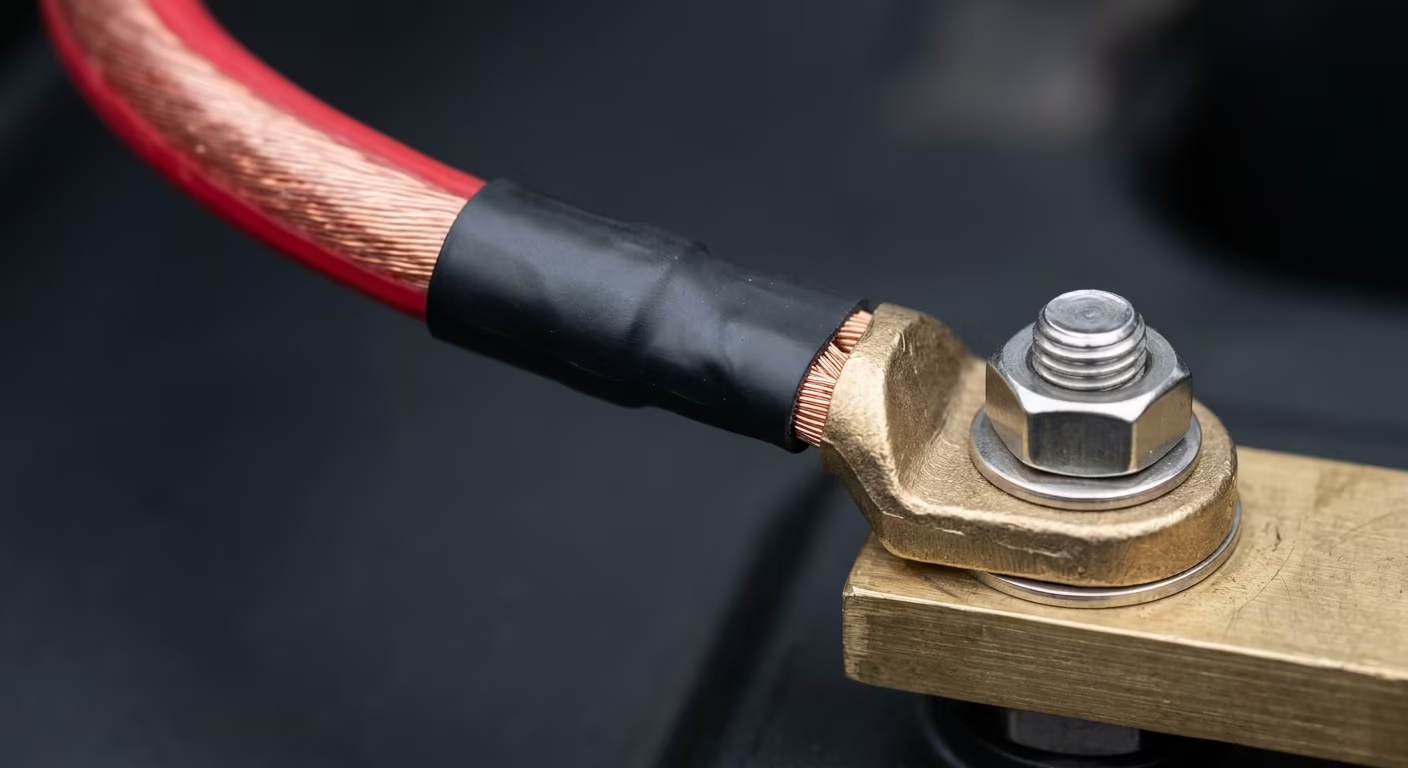
To create a 24V system, you wire two 12V lithium batteries in series (Positive to Negative). For 36V, you wire three 12V batteries in series. A critical error many boaters make is using undersized “jumper” cables between the batteries.
In a series circuit, the full load current passes through every jumper cable. If your 36V trolling motor draws 50 amps at full speed, 50 amps are flowing through the short jumper wire connecting Battery 1 to Battery 2. Because these jumpers are often bundled closely together in a hot battery compartment, they are subject to severe ambient heat.
Rule of Thumb: Battery interconnection jumpers must always be the exact same gauge—or one gauge thicker—than the main feeder cables running to the trolling motor or inverter.
24V & 36V Trolling Motor Cable Sizing Chart
Stepping up system voltage from 12V to 24V or 36V has a massive advantage: it cuts the amperage requirement drastically. A 1200W load at 12V requires 100 amps, but at 24V, it requires only 50 amps. This allows you to run thinner, more flexible cables over longer distances.
The table below highlights the ABYC recommended Tinned Copper AWG for common 24V and 36V trolling motors, targeting a conservative voltage drop to protect lithium investments (distances are total round-trip):
| System Voltage | Max Amp Draw | 10 ft Round-Trip | 20 ft Round-Trip | 30 ft Round-Trip |
|---|---|---|---|---|
| 24V (70-80 lb Thrust) | 45 – 55 Amps | 8 AWG | 6 AWG | 4 AWG |
| 36V (100-112 lb Thrust) | 40 – 50 Amps | 8 AWG | 8 AWG | 6 AWG |
| 36V (Brushless High Output) | 55 – 65 Amps | 6 AWG | 6 AWG | 4 AWG |
Frequently Asked Questions
Q: Why do I need tinned copper wire for a marine lithium system?
A: Standard bare copper wire corrodes quickly when exposed to humidity and salt air, turning green and black inside the insulation. This corrosion drastically increases electrical resistance, creating heat and voltage drop. Tinned copper (Type III stranded) coats each individual copper strand in tin, preventing oxidation and maintaining conductivity per ABYC standards.
Q: What size fuse should I use for a 36V 50A trolling motor?
A: The fuse is designed to protect the wire, not the motor. If you are using 6 AWG wire (rated for up to ~120A depending on temperature rating), a 60A to 80A Marine Rated Battery Fuse (MRBF) or waterproof resettable breaker installed within 7 inches of the battery positive terminal provides excellent protection against short circuits.
Q: Can I mix lead-acid and lithium batteries in a 24V or 36V series string?
A: Absolutely not. Lithium and lead-acid batteries have vastly different internal resistances and discharge curves. Wiring them in series will result in the lithium battery attempting to overcharge the lead-acid battery, leading to catastrophic failure, venting, or fire.
Securing Your Electrical Conduits & Cables?
Keep your electrical installations neat and code-compliant. Check out our parametric conduit clamps and cable organizers, custom-engineered and 3D printed in rugged industrial PETG.