
Quick Answer: For a standard 48-amp Level 2 EV charger on a 60-amp circuit breaker, 6 AWG copper (THHN/THWN-2 in conduit) is the National Electrical Code (NEC) standard and provides all the ampacity required. Upgrading to 4 AWG copper is only necessary if your run exceeds 100–120 feet (to prevent voltage drop), if you are installing a high-output 64-amp charger on an 80-amp breaker, or if you are running aluminum conductors instead of copper.
⚡ EV Charger Wire Sizer (NEC 625.41)
1. The NEC 125% Continuous Load Rule Explained
Electric vehicle supply equipment (EVSE) represents one of the heaviest electrical demands in modern residential installations. Unlike an electric stove or clothes dryer that cycles on and off, an EV charger draws maximum rated power uninterrupted for 4 to 8 hours.
Under NEC Article 625.41, EV charging loads are formally classified as continuous loads. The code mandates that overcurrent protection devices (circuit breakers) and branch conductors must be sized at a minimum of 125% of the charger's maximum output:
- 40A Charger: 40 A x 1.25 = 50 A Breaker
- 48A Charger: 48 A x 1.25 = 60 A Breaker
- 64A Charger: 64 A x 1.25 = 80 A Breaker
Because 48 amps is the residential hardwired charging standard for vehicles like Tesla, Rivian, and Ford, sizing for a 60-amp circuit is the benchmark scenario.
2. 6 AWG vs 4 AWG Ampacity Ratings (NEC Table 310.16)
Conductor size cannot be selected on gauge alone; the insulation type and installation method determine allowable ampacity:
| Conductor Gauge & Type | 60°C Rating (NM-B Romex) | 75°C Rating (THHN in Conduit) | 90°C Derating Base |
|---|---|---|---|
| 6 AWG Copper | 55 Amps | 65 Amps | 75 Amps |
| 4 AWG Copper | 70 Amps | 85 Amps | 95 Amps |
| 4 AWG Aluminum | 55 Amps | 65 Amps | 75 Amps |
⚠️ The Critical 6 AWG Romex (NM-B) Limitation
A frequent code violation involves running 6/3 NM-B (Romex) cable for a 48A charger on a 60A breaker.
- Per NEC 334.80, NM-B Romex must be sized from the 60°C column, which limits 6 AWG copper to 55 Amps.
- Because a 48A charger requires a 60A circuit, 6 AWG Romex is non-compliant and poses an overheating risk.
- To legally use 6 AWG copper for a 48A load, you must pull individual THHN/THWN-2 wires inside conduit (EMT or PVC), which safely operates under the 75°C column at 65 Amps.
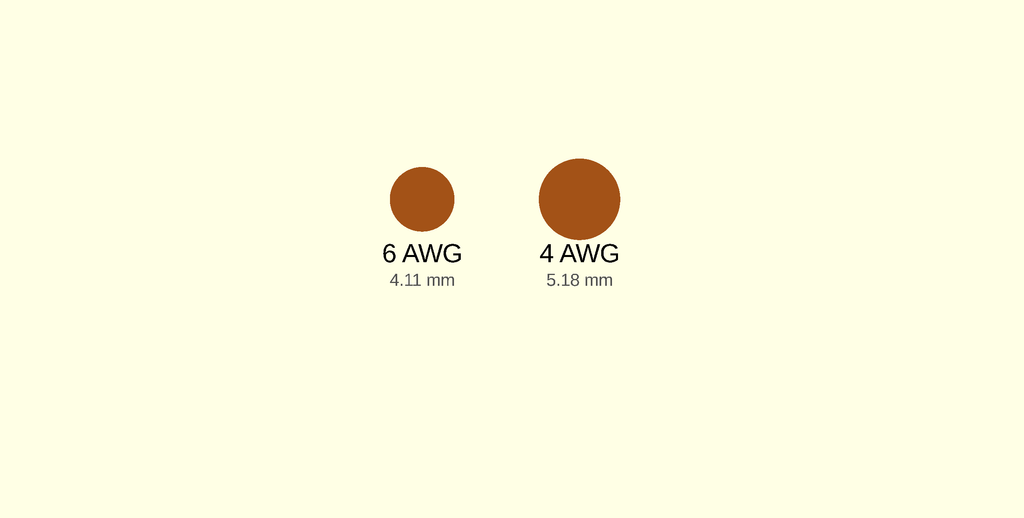
3. When Does 4 AWG Become Necessary?
While 6 AWG THHN covers standard installations, 4 AWG is required in three specific situations:
A. Extended Runs and Voltage Drop
Excessive voltage drop increases charging duration and converts electrical energy into wasted heat along the circuit length. The NEC recommends limiting voltage drop to no more than 3% on branch circuits:
- On a 240V circuit carrying a continuous 48A load, 6 AWG copper exceeds 3% voltage drop past roughly 105 feet.
- If your run from the main panel to the garage or detached outbuilding exceeds 100 feet, step up to 4 AWG copper to keep the line drop well below 3%.
B. High-Output 64A or 80A Chargers
Certain dual-motor setups, commercial units, or extended-range vehicles utilize 64A or 80A onboard chargers. Sizing for a 64A continuous load (64 A x 1.25 = 80 A Breaker) requires a minimum of 4 AWG copper, rated at 85A under the 75°C terminal column.
C. Using Aluminum Conductors
Copper prices fluctuate significantly. While 6 AWG aluminum is insufficient for a 60A circuit (rated at only 50A at 75°C), 4 AWG aluminum is rated for 65A, making it a viable alternative for budget-conscious installations—provided your terminals are rated AL/CU.
💡 The Terminal Fitment Trap
Before upgrading to 4 AWG, verify the physical lug capacity of your charging station.
- Wallbox Pulsar Plus, Emporia, and ChargePoint Home Flex: Terminals are engineered strictly for 6 AWG down to 14 AWG conductors. Jamming a 4 AWG wire into these blocks often results in clipped or frayed strands, creating a localized high-resistance hot spot.
- Tesla Universal Wall Connector: Features oversized terminal blocks specifically rated to accept 4 AWG copper directly.
If 4 AWG is required for a long run to a charger with 6 AWG-limited terminals, you must install an intermediate junction box near the EVSE to step the conductors down using Polaris connectors or insulated terminal blocks.
Frequently Asked Questions
Can I run a 48A charger on a 50A breaker with 6 AWG wire?
No. Sizing a 48A charger on a 50A breaker violates the NEC continuous load mandate (48 A x 1.25 = 60 A). If connected to a 50A circuit, the charger must be configured in software or via internal dip switches to cap its output at 40 amps.
Is ground wire also required to be 6 AWG or 4 AWG?
No. Per NEC Table 250.122, an equipment grounding conductor (EGC) for a 60A circuit requires only 10 AWG copper. For an 80A circuit, an 8 AWG copper ground is standard.
What size conduit is required for 6 AWG vs 4 AWG?
For three current-carrying THHN conductors (two hots and an equipment ground) in EMT conduit:
- 6 AWG THHN: Fits within standard 3/4-inch EMT (under the 40% fill limit).
- 4 AWG THHN: Requires upgrading to 1-inch EMT to maintain safe pull tensions and NEC Chapter 9 conduit fill compliance.